

Organisations across Canada are discovering that strategic workforce development represents one of the most powerful competitive advantages available in today's rapidly evolving business landscape. As technological disruption accelerates and workplace expectations shift, the quality of your team's skills directly determines your organisation's capacity to innovate, adapt, and thrive. Corporate training courses have evolved far beyond traditional classroom lectures into sophisticated learning experiences that drive measurable business outcomes. Whether you're addressing skills gaps, preparing for digital transformation, or cultivating tomorrow's leaders, selecting the right training approach requires understanding both current market trends and your organisation's unique development needs.
Understanding the Strategic Value of Workplace Learning
Corporate training courses deliver quantifiable returns across multiple business dimensions when implemented thoughtfully. Research consistently demonstrates that organisations investing in structured employee development experience higher retention rates, improved productivity, and stronger employee engagement scores compared to competitors who neglect workforce development.
The financial impact extends beyond immediate performance improvements. Companies with comprehensive training programmes reduce costly turnover by creating clear career progression pathways that motivate high performers to stay engaged long-term. When employees see their employer investing in their growth, loyalty increases substantially.
Key business benefits include:
- Enhanced employee performance and productivity levels
- Reduced recruitment and onboarding expenses
- Improved workplace safety and compliance adherence
- Stronger innovation capacity through upskilled teams
- Better customer satisfaction driven by competent staff
- Increased organisational agility during change initiatives

Beyond these tangible metrics, training investments signal to your workforce that their development matters. This psychological contract strengthens organisational culture and creates environments where continuous improvement becomes embedded in daily operations rather than treated as an occasional initiative.
Essential Categories of Corporate Training Programmes
Modern organisations require diverse training solutions addressing different skill domains and business priorities. Understanding these categories helps learning and development professionals construct comprehensive programmes that support strategic objectives.
Leadership and Management Development
Leadership capabilities determine organisational effectiveness at every level. Leadership and management courses develop the competencies that transform individual contributors into effective people leaders and seasoned managers into strategic executives.
These programmes typically address decision-making frameworks, team motivation techniques, performance management systems, and strategic thinking capabilities. Organisations investing in leadership presence and confidence development create stronger management layers capable of navigating complexity whilst inspiring their teams.
| Leadership Training Focus | Primary Outcomes | Ideal Participants |
|---|---|---|
| New Manager Transition | Delegation, feedback delivery, team building | Recently promoted supervisors |
| Strategic Leadership | Vision development, change management, innovation | Senior executives, directors |
| Emotional Intelligence | Self-awareness, relationship management, empathy | All leadership levels |
| Resilience Under Pressure | Stress management, decision-making, composure | High-pressure role holders |
Communication and Interpersonal Skills
Workplace effectiveness relies heavily on how well team members exchange information, resolve conflicts, and collaborate across boundaries. Communication and interpersonal skills training addresses everything from presentation delivery to difficult conversations.
Programmes focusing on emotionally intelligent workplace communication help employees navigate diverse personalities, generational differences, and remote work challenges that characterise modern organisations.
Technical and Software Proficiency
As digital transformation reshapes every industry, technical competency becomes increasingly critical. Software skills and workplace essentials ensure teams can leverage productivity tools, data analytics platforms, and industry-specific applications effectively.
These corporate training courses range from foundational digital literacy for workers transitioning into technology-enabled roles to advanced specialised training for technical professionals requiring cutting-edge capabilities.
Professional Development and Workplace Culture
Broader professional development initiatives address workplace behaviours, personal effectiveness, and organisational culture strengthening. Topics span time management, stress resilience, habit formation, and change adaptation.
Courses like building lasting workplace habits help employees develop sustainable practices that compound over time, whilst programmes focused on nervous system regulation and stress prevention address the wellbeing challenges that can undermine performance.
Choosing Between Delivery Methods and Formats
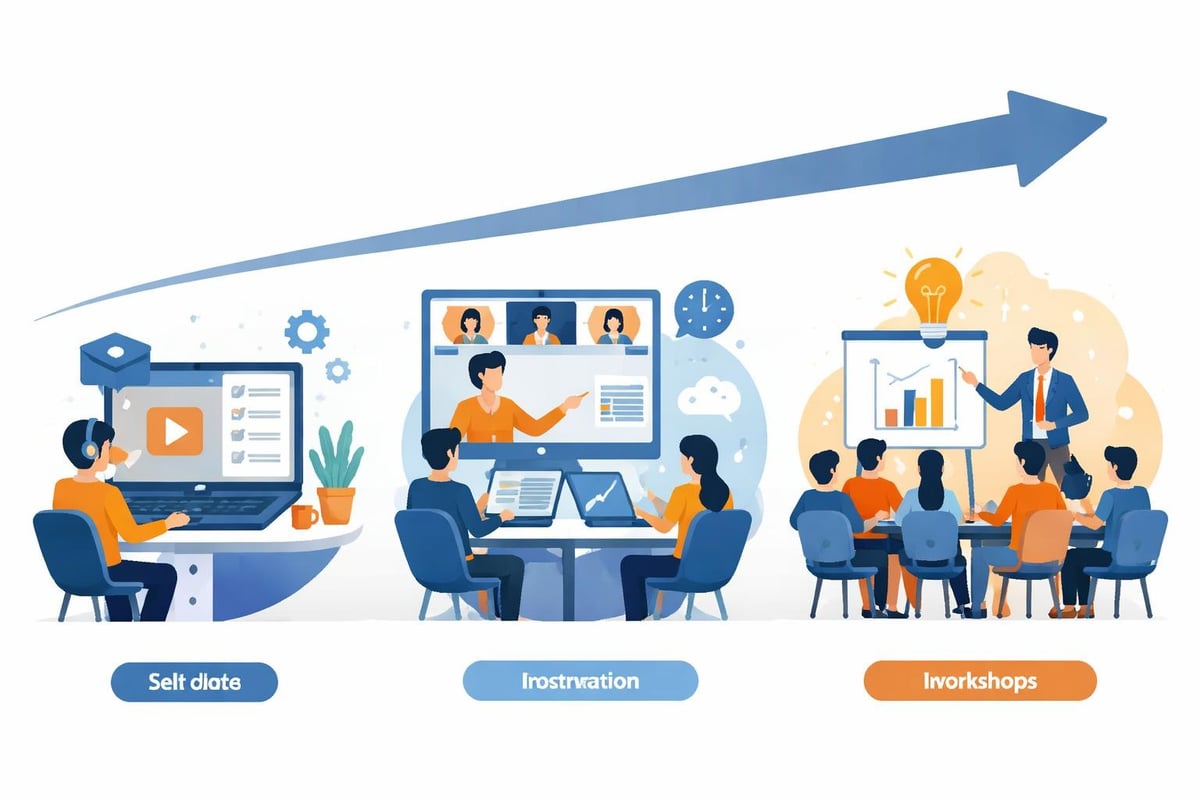
Corporate training courses come in multiple delivery formats, each offering distinct advantages depending on your organisational context, budget parameters, and learning objectives. According to research on corporate training effectiveness, the optimal approach often combines multiple modalities rather than relying exclusively on a single method.
Instructor-Led Training Advantages
Traditional instructor-led training remains highly effective for complex topics requiring interactive discussion, hands-on practice, and immediate feedback. Skilled facilitators adapt content dynamically based on participant needs, address questions in real-time, and create networking opportunities amongst attendees.
This format proves particularly valuable for:
- Leadership development programmes requiring scenario analysis
- Interpersonal skills training benefiting from role-play exercises
- Change management initiatives needing facilitated group discussion
- Technical workshops involving hands-on tool practice
Organisations can access instructor-led programmes through in-person sessions at training facilities or by bringing facilitators on-site for customised delivery aligned with specific business contexts.
Virtual and Online Learning Solutions
Online courses offer flexibility and scalability that traditional classroom training cannot match. Employees learn at their own pace, revisit challenging concepts, and complete programmes without travel requirements or schedule disruptions.
Virtual instructor-led training combines the interactivity of traditional classrooms with the convenience of remote participation, enabling organisations to train geographically dispersed teams simultaneously whilst maintaining engagement levels.
| Delivery Method | Best For | Key Limitations |
|---|---|---|
| In-Person Classroom | Complex skills, team building, hands-on practice | Travel costs, scheduling challenges, limited scalability |
| Virtual Instructor-Led | Distributed teams, interactive learning at scale | Technology requirements, engagement maintenance |
| Self-Paced Online | Compliance training, knowledge acquisition, flexible learning | Lower completion rates, minimal interaction |
| Blended Learning | Comprehensive programmes combining knowledge and application | Coordination complexity, resource intensive |
Sourcing Quality Training Content and Providers
Developing effective corporate training courses requires accessing quality content from reliable sources. Many organisations struggle determining whether to build programmes internally or partner with external providers.
Internal Development Approaches
Leveraging internal subject matter experts offers contextual relevance that generic programmes cannot match. Your senior leaders understand company-specific challenges, industry nuances, and organisational culture factors that influence training effectiveness.
Resources like ten content sources for corporate training programs outline approaches including subject matter expert interviews, process documentation, and performance data analysis. However, internal development demands significant time investment and instructional design expertise many organisations lack.
External Training Partnerships
Working with specialised training providers delivers professionally designed programmes backed by research, tested methodologies, and experienced facilitators. Established providers offer structured curricula, proven delivery systems, and measurable assessment frameworks.
Platforms like findcourses aggregate thousands of corporate training courses from various providers, enabling comparison shopping. Additionally, curated lists of top corporate training companies help organisations identify reputable partners with track records in specific industries or skill domains.
The most sophisticated organisations blend internal and external resources, using providers for foundational content whilst customising delivery to address unique business contexts. This hybrid approach balances cost efficiency with contextual relevance.
Designing Comprehensive Training Programmes
Isolated training events rarely produce lasting behavioural change or meaningful business impact. Effective workforce development requires systematic programme design connecting learning experiences to performance support and business outcomes.
Conducting Needs Analysis
Successful corporate training courses begin with thorough needs assessment identifying specific performance gaps, business priorities, and learner characteristics. This analysis examines current versus desired competency levels, exploring root causes behind performance deficits.
Questions guiding needs analysis include:
- What business challenges will this training address?
- Which specific behaviours or skills require development?
- Who needs training and what's their current proficiency level?
- What organisational barriers might prevent application?
- How will success be measured and tracked?
Structuring Learning Journeys
Rather than standalone events, design learning journeys spanning multiple touchpoints over time. A comprehensive leadership programme might include pre-work assessments, a multi-day workshop, monthly coaching sessions, peer learning groups, and post-programme reinforcement activities.
This spaced repetition and varied practice format drives retention far more effectively than concentrated one-time events. The professional development resources available through specialised providers often include follow-up materials supporting ongoing application.
Customisation and Contextualisation
Generic off-the-shelf corporate training courses provide foundational frameworks, but customisation significantly enhances relevance and application rates. Tailoring case studies, examples, activities, and terminology to reflect your industry, company challenges, and participant roles increases engagement whilst demonstrating practical applicability.
Many training providers, including comprehensive networks offering extensive course catalogues, provide customisation services adapting standard curricula to specific organisational contexts without requiring complete custom development.
Measuring Training Effectiveness and ROI
Demonstrating training value remains challenging for many organisations, yet measurement capabilities determine whether learning and development secures ongoing investment and strategic priority. Effective evaluation extends beyond participant satisfaction surveys to encompass behavioural change and business impact.
The Four Levels of Evaluation
The Kirkpatrick Model provides a structured framework assessing training at progressively deeper levels:
Level 1: Reaction measures participant satisfaction through post-course surveys capturing perceived relevance, facilitator effectiveness, and logistical quality.
Level 2: Learning evaluates knowledge and skill acquisition through assessments, demonstrations, or competency tests administered before and after training.
Level 3: Behaviour examines whether participants apply new capabilities in workplace contexts, typically measured through manager observations, self-assessments, or 360-degree feedback several weeks post-training.
Level 4: Results connects training to business outcomes including productivity improvements, quality enhancements, cost reductions, or revenue increases attributable to changed behaviours.

Establishing Baseline Metrics
Meaningful evaluation requires establishing baseline performance before training interventions. Document current state metrics relevant to your training objectives, whether customer satisfaction scores for service training, safety incident rates for compliance programmes, or sales conversion rates for commercial skills development.
Compare post-training performance against these baselines rather than arbitrary targets, isolating training impact from other variables influencing results. Sophisticated organisations employ control groups or statistical methods accounting for confounding factors.
Long-Term Tracking Systems
Training impact often emerges gradually as new behaviours become habitual and compound over time. Single post-course measurements miss delayed effects and sustainability questions. Implement tracking systems measuring key indicators at 30, 60, and 90-day intervals following programme completion.
This longitudinal approach reveals whether initial enthusiasm translates into sustained practice whilst identifying support needs that emerge during application phases. Platforms providing comprehensive training solutions often include measurement frameworks supporting ongoing evaluation.
Emerging Trends Shaping Corporate Training in 2026
The corporate training landscape continues evolving rapidly as technology advances, workforce demographics shift, and business environments grow increasingly complex. Staying informed about emerging trends helps organisations maintain competitive training programmes.
Personalised Learning Pathways
Artificial intelligence and adaptive learning technologies enable personalised training experiences tailored to individual learning styles, existing knowledge levels, and career aspirations. Rather than everyone completing identical programmes, learners follow customised pathways addressing their specific development needs.
This personalisation increases engagement whilst improving efficiency by avoiding redundant content covering skills learners already possess. The approach mirrors consumer experiences with personalised content recommendations, meeting modern learner expectations.
Microlearning and Just-in-Time Support
Attention spans decline whilst workplace pace accelerates, driving demand for bite-sized learning resources accessible precisely when needed. Microlearning modules delivering focused content in 5-10 minute segments enable learning integration into workflow rather than requiring dedicated training time.
Just-in-time performance support provides guidance at the moment of need, whether video tutorials accessed during software use or decision frameworks consulted before critical conversations. This approach complements formal corporate training courses by bridging the gap between initial learning and ongoing application.
Immersive and Experiential Learning
Virtual reality, augmented reality, and sophisticated simulations create immersive practice environments where learners develop skills through realistic scenarios without real-world consequences. These technologies prove particularly valuable for high-stakes situations including emergency response, difficult conversations, or complex technical procedures.
Experiential learning methodologies emphasise active participation, reflection, and application rather than passive information consumption. Courses incorporating role-plays, case analysis, action learning projects, and field assignments produce stronger behavioural change than lecture-based approaches.
Skills-Based Talent Development
Forward-thinking organisations shift from job-based to skills-based talent strategies, cataloguing workforce capabilities and mapping development pathways enabling internal mobility. This approach positions corporate training courses as building blocks within broader career architecture rather than isolated events.
Skills taxonomies identify transferable capabilities spanning multiple roles, enabling more strategic workforce planning and development investment. Resources like comprehensive course topic directories help organisations identify training addressing specific competency requirements.
Building a Culture of Continuous Learning
Sustainable competitive advantage requires embedding learning into organisational DNA rather than treating development as periodic training events. Companies cultivating continuous learning cultures adapt faster, innovate more effectively, and attract higher-calibre talent than competitors with stagnant development approaches.
Leadership Modelling and Support
Learning culture begins at the top. When executives visibly prioritise their own development, participate in training programmes, and discuss their learning journeys, employees recognise that growth matters throughout the organisation. Leaders must allocate time for learning, celebrate skill development, and remove barriers preventing participation.
Manager support particularly influences whether training translates into workplace application. Supervisors who discuss training takeaways, provide practice opportunities, and reinforce new behaviours dramatically increase programme effectiveness compared to managers who ignore or undermine development initiatives.
Creating Learning Infrastructure
Continuous learning requires supporting infrastructure including accessible content libraries, learning management systems tracking development, mentoring programmes, communities of practice, and knowledge sharing platforms. This ecosystem enables informal learning complementing formal corporate training courses.
Organisations should curate diverse learning resources spanning multiple formats and difficulty levels, ensuring employees can find relevant materials regardless of their starting point or preferred learning style. Professional training networks offering extensive instructor-led options alongside self-paced alternatives provide the variety supporting different learning preferences.
Recognition and Career Integration
Learning cultures recognise and reward development through both formal recognition programmes and career advancement opportunities. When promotions consistently go to individuals demonstrating continuous skill building, others notice and adjust their behaviours accordingly.
Integrating learning goals into performance management processes, succession planning frameworks, and compensation decisions signals that development represents core organisational values rather than optional activities. This integration transforms training from "nice to have" into business-critical investment worthy of protected time and resources.
Investing in comprehensive corporate training courses represents one of the most strategic decisions organisations can make in 2026's competitive landscape. By understanding training categories, selecting appropriate delivery methods, designing systematic programmes, and measuring impact rigorously, you create workforce capabilities that drive sustained business success. My Training Network specialises in delivering customisable, high-impact training solutions across Canada and globally, offering over 150 expert-led courses that transform teams and elevate organisational performance. Whether you need leadership development, technical skills training, or comprehensive learning programmes, our experienced instructors and proven methodologies deliver measurable results that justify your training investment.

