

Organisations across Canada and beyond are recognising that their workforce represents their most valuable asset, and investing in employee development has become a strategic imperative rather than a discretionary expense. Corporate training programs have evolved significantly from basic orientation sessions to sophisticated, multi-faceted learning ecosystems that drive measurable business outcomes. In 2026, successful organisations are leveraging comprehensive training initiatives to address skills gaps, accelerate digital transformation, and build resilient leadership pipelines. Whether delivered through instructor-led workshops, virtual classrooms, or blended learning approaches, these programs are reshaping how companies compete in an increasingly knowledge-driven economy.
The Strategic Value of Corporate Learning Initiatives
Corporate training programs deliver tangible returns when aligned with business objectives and executed with precision. Research consistently demonstrates that organisations investing in structured learning initiatives experience higher employee retention, improved productivity, and stronger competitive positioning. The most effective programs extend beyond compliance requirements to address critical business challenges and future-proof the workforce.
Key business outcomes include:
- Enhanced employee performance and productivity
- Reduced turnover and associated recruitment costs
- Accelerated onboarding and time-to-competency
- Stronger leadership pipeline development
- Improved innovation and adaptability
Organisations implementing comprehensive instructor-led training approaches report particularly strong results when programs are customised to specific industry contexts and organisational cultures. The personalisation factor proves especially valuable in addressing nuanced challenges that generic content cannot adequately resolve.

Building a Business Case for Training Investment
Finance leaders increasingly demand rigorous justification for training expenditures, requiring learning professionals to demonstrate clear connections between programs and financial performance. Successful business cases quantify both direct costs (trainer fees, materials, technology platforms) and opportunity costs (employee time away from productive work) whilst projecting realistic benefits across multiple dimensions.
The most compelling proposals incorporate baseline performance metrics, projected improvements, and conservative ROI calculations. According to research on strategies for measuring corporate training success, organisations using structured evaluation frameworks achieve significantly better outcomes than those relying on subjective assessments alone.
| Metric Category | Measurement Approach | Typical Data Sources |
|---|---|---|
| Learning Outcomes | Knowledge assessments, skill demonstrations | Tests, simulations, observations |
| Behavioural Change | On-the-job application, manager feedback | Performance reviews, 360° surveys |
| Business Impact | Productivity, quality, customer satisfaction | KPI dashboards, financial reports |
| ROI Calculation | Benefit-cost ratio, payback period | Comprehensive financial analysis |
Designing Effective Corporate Training Programs
Programme design represents the foundation upon which all successful corporate learning initiatives are built. The most effective approaches begin with thorough needs analysis, examining performance gaps at organisational, departmental, and individual levels. This diagnostic phase identifies not only what skills require development but also the underlying causes of performance challenges.
A Cornell University study identified key strategies to improve corporate training programs, emphasising the importance of self-coaching techniques and anonymous feedback mechanisms. These evidence-based approaches significantly enhance knowledge retention and behavioural application compared to traditional lecture-based formats.
Selecting the Right Training Modalities
Modern corporate training programs leverage diverse delivery methods, each offering distinct advantages depending on learning objectives, audience characteristics, and logistical constraints. The choice between instructor-led workshops, virtual training, self-paced modules, or blended approaches should reflect strategic considerations rather than default preferences.
Instructor-led training excels when:
- Complex concepts require real-time clarification
- Hands-on practice with immediate feedback is essential
- Team dynamics and collaborative learning add value
- Behavioural skills like communication or leadership are the focus
Virtual delivery has matured considerably, with e-learning in corporate training programs demonstrating comparable effectiveness to in-person instruction when properly designed. The economic benefits of virtual training-eliminating travel costs and enabling broader participation-make it particularly attractive for geographically dispersed teams.
Organisations exploring their full training portfolio should review the comprehensive courses available to understand how different modalities support varying learning objectives and organisational needs.
Implementing High-Impact Learning Initiatives
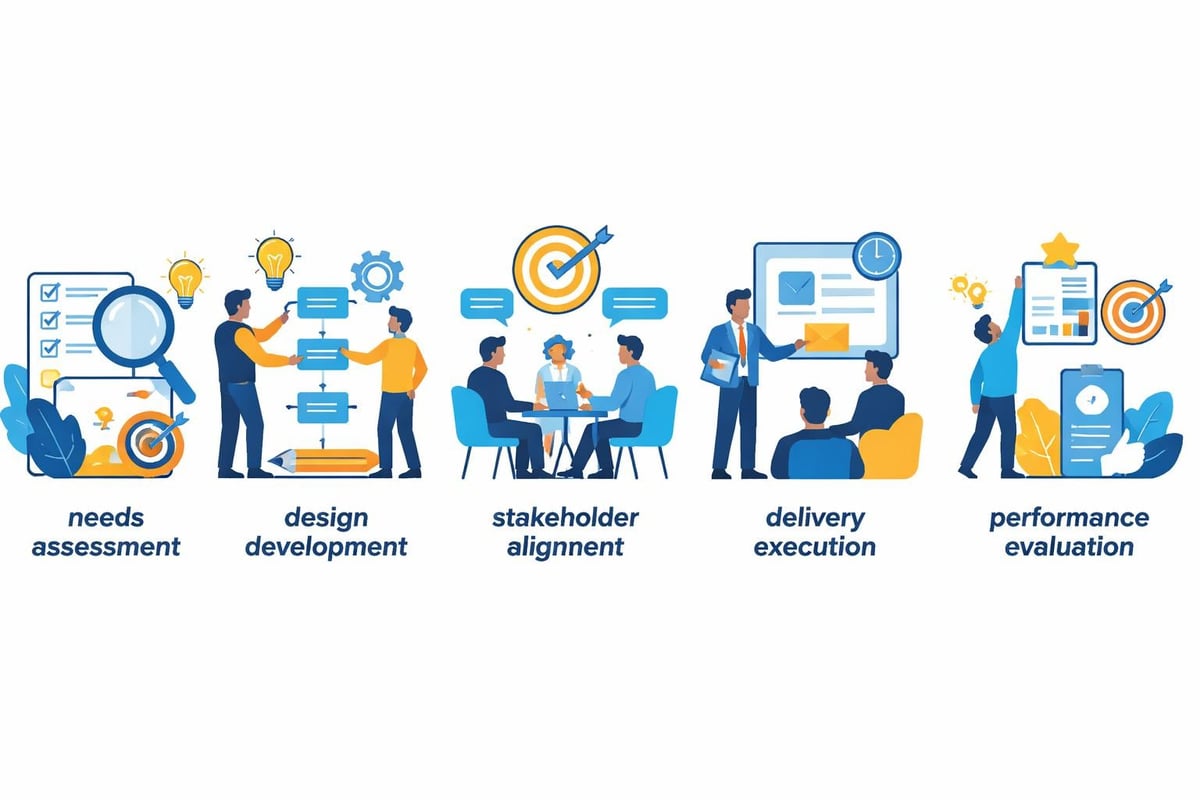
Implementation quality determines whether well-designed programs achieve their potential or fall short despite excellent content. Successful rollouts require meticulous attention to logistical details, stakeholder communication, and participant preparation. The most common implementation failures stem from inadequate manager engagement, poor scheduling that conflicts with operational demands, or insufficient technical preparation for virtual delivery.
Driving Learner Engagement and Adoption
Even exceptional content fails without active participant engagement. Implementing best practices for increasing user adoption in corporate training significantly improves completion rates and knowledge application. These strategies address both motivational factors (relevance, career benefits) and practical considerations (time availability, competing priorities).
Proven engagement strategies include:
- Securing visible executive sponsorship and participation
- Clearly articulating personal and organisational benefits
- Scheduling training during optimal periods avoiding peak operational demands
- Creating accountability through manager involvement
- Recognising and celebrating learning achievements
Managers play a particularly critical role as they set expectations, allocate time for learning activities, and reinforce application of new skills. Organisations that invest in preparing managers to support learning initiatives report substantially higher training effectiveness than those treating managers as passive bystanders.
The integration of emotionally intelligent workplace communication principles throughout training delivery enhances participant receptivity and creates psychologically safe learning environments where employees feel comfortable acknowledging knowledge gaps and practising new skills.
Customising Programs for Organisational Context
Generic, off-the-shelf training rarely delivers optimal results because it cannot address the specific challenges, terminology, systems, and cultural norms that shape daily work experiences. Corporate training programs achieve greatest impact when customised to reflect organisational realities whilst maintaining evidence-based instructional approaches.
Customisation operates at multiple levels, from incorporating company-specific case studies and examples to adjusting content emphasis based on particular performance gaps. Case studies showcasing successful corporate learning initiatives demonstrate how organisations across various sectors have adapted training frameworks to their unique contexts whilst maintaining programmatic rigour.
Addressing Industry-Specific Requirements
Different sectors face distinct training challenges requiring specialised approaches. Financial services organisations prioritise regulatory compliance and risk management, technology companies focus on rapidly evolving technical skills, and healthcare providers emphasise patient safety and clinical competencies. Understanding these sector-specific imperatives ensures training investments address the most critical capabilities.
The best practices in needs analysis for corporate programs highlight the importance of aligning learning objectives with both role-specific requirements and broader organisational competency frameworks. This alignment ensures training contributes to strategic workforce planning rather than existing as an isolated activity.
| Industry Sector | Primary Training Focus Areas | Typical Program Duration |
|---|---|---|
| Financial Services | Compliance, risk management, client relations | 2-5 days per topic |
| Technology | Technical skills, agile methodologies, innovation | 1-3 days, ongoing |
| Healthcare | Clinical competencies, patient safety, regulatory | 3-7 days, recurring |
| Manufacturing | Safety protocols, quality systems, lean principles | 2-4 days, periodic |
Developing Leadership Through Structured Programs
Leadership development represents one of the highest-value applications of corporate training programs, as effective leaders multiply organisational capacity through their influence on teams and strategic decisions. Yet leadership training often disappoints when it emphasises abstract concepts over practical application or treats leadership as a generic skillset rather than context-dependent capabilities.
The most effective leadership programs combine theoretical frameworks with realistic practice opportunities, enabling participants to experiment with new approaches in controlled environments before applying them to high-stakes situations. Specialised offerings in leadership management courses address the full spectrum of leadership competencies from foundational supervisory skills to executive-level strategic thinking.
Building Resilient Leaders for Complex Environments
The operating environment facing leaders in 2026 demands unprecedented adaptability, with technological disruption, remote work models, and multigenerational teams creating complexity unknown to previous generations. Training programs addressing resilient leadership under pressure equip leaders with practical techniques for maintaining performance during uncertainty whilst supporting team wellbeing.
Essential leadership competencies for contemporary environments:
- Emotional intelligence and self-awareness
- Adaptive decision-making under ambiguity
- Virtual team leadership and engagement
- Change management and organisational agility
- Inclusive leadership across diverse teams
Progressive organisations are incorporating neuroscience-based approaches through programs like leading through neuroscience and emotional intelligence, which ground leadership development in evidence about how humans actually process information, form relationships, and respond to stress.

Measuring Training Effectiveness and ROI
Measurement represents both the greatest challenge and most critical success factor in corporate training programs. Without rigorous evaluation, organisations cannot distinguish effective initiatives from wasteful expenditure or make informed decisions about future investments. Yet many organisations struggle to move beyond simple satisfaction surveys that reveal little about actual learning or business impact.
The Kirkpatrick Model provides a structured framework, evaluating training across four levels: reaction (participant satisfaction), learning (knowledge acquisition), behaviour (on-the-job application), and results (business outcomes). Whilst measuring higher levels requires greater effort, these metrics provide the most meaningful insights into program value.
Creating Actionable Evaluation Systems
Effective evaluation systems balance comprehensiveness with practicality, recognising that perfect measurement should not obstruct timely action. The most sophisticated approaches establish baseline performance metrics before training, measure immediate learning outcomes, assess behavioural change at 30-60-90 day intervals, and track relevant business metrics over extended periods.
According to ten best practices for effective corporate training programs, continuous improvement mechanisms that incorporate evaluation data into program refinement distinguish high-performing learning organisations from those treating training as a static offering.
Practical measurement approaches include:
- Pre- and post-training knowledge assessments
- Manager observations of skill application
- Customer satisfaction or quality metrics
- Productivity or efficiency indicators
- Employee engagement and retention data
Organisations seeking to enhance their evaluation capabilities can explore courses on data fluency and performance metrics that build analytical capabilities across the workforce, enabling more sophisticated approaches to training measurement.
Addressing Modern Workplace Challenges
Contemporary corporate training programs must address challenges that barely existed a decade ago, from responsible artificial intelligence usage to managing distributed teams across multiple time zones. The most forward-thinking organisations use training strategically to navigate these emerging challenges rather than simply reacting to crises.
Courses addressing responsible AI use in the workplace exemplify this proactive approach, preparing employees to leverage transformative technologies whilst mitigating risks around bias, privacy, and ethical application. Similarly, programs focused on building high-performance habits recognise that sustained productivity in hybrid work environments requires intentional behaviour design rather than relying on traditional office structures.
Supporting Employee Wellbeing Through Learning
The recognition that employee wellbeing directly impacts performance has elevated training topics previously considered peripheral to core business concerns. Programs addressing stress management, work-life integration, and psychological safety now represent strategic investments rather than nice-to-have benefits. Research on team building and training case studies demonstrates measurable improvements in both engagement and performance when organisations prioritise wellbeing alongside technical skill development.
Specialised offerings like stress and burnout recovery strategies and nervous system regulation provide employees with evidence-based techniques for maintaining sustainable performance whilst organisations benefit from reduced absenteeism and turnover.
Scaling Training Across Growing Organisations
Organisations experiencing rapid growth face particular challenges in maintaining training quality and consistency whilst expanding delivery capacity. The approaches that work for 50 employees often fail at 500 or 5,000, requiring systematic thinking about trainer certification, content standardisation, quality assurance, and technology infrastructure.
Successful scaling typically involves developing robust learning management systems, creating comprehensive trainer guides and materials, implementing regular quality audits, and establishing clear governance around content updates and delivery standards. Virtual delivery options through online courses enable organisations to reach broader audiences whilst maintaining consistency in learning experiences.
Building Internal Training Capability
Many organisations balance external training partnerships with internal capability development, creating hybrid models that leverage external expertise for specialised topics whilst building internal capacity for core competencies. This approach requires investment in trainer development, content creation systems, and quality assurance processes.
The decision between building and buying training capability should reflect strategic considerations including training volume, content specificity, required expertise levels, and budget constraints. Partnering with established providers offers immediate access to proven content and experienced facilitators whilst internal development provides greater customisation and long-term cost efficiency for high-volume topics.
| Approach | Best Applications | Primary Advantages | Key Considerations |
|---|---|---|---|
| External Partners | Specialised topics, leadership development | Immediate expertise, proven content | Higher per-participant costs |
| Internal Development | Core competencies, high-volume topics | Customisation, lower marginal costs | Initial investment, quality variability |
| Hybrid Model | Balanced portfolio | Flexibility, cost optimisation | Coordination complexity |
Leveraging Technology in Learning Delivery
Technology has fundamentally transformed corporate training programs, enabling delivery modes and learning experiences impossible in traditional classroom settings. From virtual reality simulations providing risk-free practice environments to adaptive learning platforms personalising content based on individual progress, technological innovation continues expanding what effective training can achieve.
Yet technology represents an enabler rather than a solution itself. The most common failure mode involves prioritising technological sophistication over sound instructional design, resulting in impressive platforms delivering mediocre learning outcomes. Successful technology integration begins with clear learning objectives and deploys tools strategically to enhance achievement of those objectives.
Courses addressing communication that gets results demonstrate how blended approaches combining virtual delivery with practical application exercises can achieve outcomes comparable to traditional instructor-led formats whilst offering greater scheduling flexibility and reduced costs. The key lies in thoughtful design that leverages each modality's strengths rather than simply replicating classroom experiences through video conferencing.
Corporate training programs represent strategic investments that drive competitive advantage when executed with clear objectives, rigorous design, and ongoing evaluation. Organisations that approach learning systematically-aligning programs with business goals, customising content to organisational context, and measuring outcomes rigorously-consistently outperform competitors treating training as a compliance exercise or discretionary benefit. Whether your organisation needs to develop emerging leaders, build technical capabilities, or navigate transformational change, My Training Network delivers customisable, instructor-led training solutions across Canada and globally. Our network of expert trainers and comprehensive course catalogue provides the expertise and flexibility to address your specific development challenges and achieve measurable business results.

