

Organizations in Saskatoon face unique challenges when developing their workforce in a competitive, evolving business landscape. From addressing skills gaps to fostering leadership capabilities, the need for high-quality corporate training saskatoon solutions has never been more critical. Whether you're a small business seeking to enhance customer service skills or a larger organization implementing comprehensive leadership development programmes, access to professional training services can transform your team's performance and drive measurable business results.
Understanding the Corporate Training Landscape in Saskatoon
Saskatoon's diverse economy, spanning sectors from agriculture and mining to technology and healthcare, creates varied training requirements across industries. Corporate training saskatoon providers must understand these sector-specific needs whilst delivering programmes that address universal workplace competencies.
The training landscape has evolved significantly in recent years. Organizations no longer seek generic, one-size-fits-all workshops. Instead, they demand customized solutions that align with specific business objectives, company culture, and workforce demographics. This shift reflects a broader understanding that effective corporate training requires alignment with organizational goals and measurable outcomes.
Key Training Categories for Saskatoon Businesses
Modern corporate training encompasses several critical areas that drive organizational success:
- Leadership and management development programmes that prepare emerging leaders and strengthen existing management teams
- Communication and interpersonal skills training that enhances collaboration and workplace relationships
- Technical and software competency workshops addressing industry-specific tools and platforms
- Client experience and sales effectiveness courses that improve customer interactions and revenue generation
- Project management and organizational skills development for increased efficiency

Selecting the Right Training Provider for Your Organization
Choosing a corporate training saskatoon partner requires careful evaluation of several critical factors. The provider's expertise, delivery methods, and track record directly impact training effectiveness and return on investment.
Instructor quality stands as the most crucial consideration. Qualified instructors with real-world experience bring practical insights that resonate with adult learners far more effectively than theoretical presentations. Look for trainers who combine subject matter expertise with proven facilitation skills and industry credentials.
Evaluating Training Delivery Options
| Delivery Method | Benefits | Best For |
|---|---|---|
| In-person instructor-led | High engagement, hands-on practice, immediate feedback | Team-building, complex skills, collaborative learning |
| Virtual instructor-led | Geographic flexibility, reduced costs, accessible recording | Remote teams, budget constraints, ongoing reference |
| Blended learning | Combines benefits, flexible pacing, multiple touchpoints | Comprehensive programmes, diverse learning styles |
| On-demand resources | Self-paced, convenient access, individual needs | Supplementary learning, reference materials, refreshers |
Geographic considerations matter less today than in previous years. While local providers understand Saskatoon's business community, virtual training best practices have advanced to deliver comparable engagement and results regardless of trainer location. Organizations can access Canada's top instructors without travel expenses or scheduling complications.
Designing Effective Corporate Training Programmes
Successful corporate training saskatoon initiatives begin with thorough needs assessment. Understanding current skill levels, identifying gaps, and defining desired outcomes ensures training investments deliver tangible value. This assessment should involve input from multiple stakeholders, including department leaders, human resources, and employees themselves.
Programme design must balance comprehensive coverage with practical application. Best practices in corporate training emphasize the importance of relevant, engaging content that learners can immediately apply in their roles. Theoretical knowledge without practical application rarely produces lasting behaviour change.
Critical Success Factors
Customization transforms generic content into powerful learning experiences. Off-the-shelf courses may cover relevant topics, but customization addresses your organization's specific challenges, uses familiar examples, and incorporates company-specific processes and terminology.
Engagement strategies maintain learner attention and facilitate knowledge retention. Interactive exercises, group discussions, case studies, and role-playing scenarios create memorable learning moments that stick far longer than passive lectures.
Follow-up mechanisms extend learning beyond the initial session. Reinforcement activities, coaching support, and accountability structures help learners translate new knowledge into consistent workplace behaviours.
Popular Training Topics for Saskatoon Organizations
Certain training topics consistently deliver value across industries and organization sizes. Understanding which programmes address your most pressing needs helps prioritize training investments and maximize impact.
Leadership development remains the most requested corporate training saskatoon category. As businesses grow and evolve, they need leaders who can inspire teams, drive performance, and navigate change effectively. Leadership programmes should cover delegation, decision-making, coaching, performance management, and strategic thinking.

Communication Skills Training
Effective communication underpins every successful business interaction. Organizations investing in communication and interpersonal skills development see improvements in team collaboration, client relationships, and organizational culture.
- Presentation skills training helps employees deliver compelling, confident presentations to internal and external audiences
- Business writing courses enhance email communication, report creation, and professional correspondence
- Active listening workshops improve understanding, reduce miscommunication, and strengthen relationships
- Difficult conversations training equips managers and employees to address sensitive topics constructively
- Conflict resolution programmes provide frameworks for managing disagreements and finding mutually beneficial solutions
These skills transcend job titles and departments, making communication training valuable for organizations at every level.
Implementing Training Across Your Saskatoon Organization
Rolling out corporate training saskatoon programmes requires strategic planning to ensure participation, engagement, and application. Organizations that treat training as a strategic initiative rather than a compliance checkbox achieve significantly better results.
Timing considerations affect training effectiveness substantially. Avoid scheduling sessions during peak business periods when participants feel distracted by urgent work demands. Consider quarterly training calendars that distribute learning throughout the year rather than concentrating everything into a single intensive period.
Participant selection should balance operational needs with development opportunities. While it's tempting to exclude top performers from training to keep them productive, these individuals often benefit most from advanced programmes and can serve as champions for implementing new practices.
Measuring Training Effectiveness
| Measurement Level | What It Measures | Assessment Methods |
|---|---|---|
| Reaction | Participant satisfaction and engagement | Post-training surveys, feedback forms |
| Learning | Knowledge and skill acquisition | Tests, demonstrations, assessments |
| Behaviour | On-the-job application of learning | Observation, 360 reviews, manager reports |
| Results | Business impact and ROI | Performance metrics, productivity data, revenue changes |
Effective measurement combines multiple levels to provide comprehensive understanding of training value. Immediate feedback surveys capture participant reactions, whilst longer-term observation and performance data reveal actual behaviour change and business impact.
Leveraging Local and National Training Resources
Saskatoon organizations benefit from both local training institutions and national providers with expertise across industries. Saskatchewan Polytechnic offers customized corporate training solutions with strong connections to regional industry needs and flexible delivery options.
National training networks provide access to specialized expertise that may not be available locally. My Training Network connects Saskatoon organizations with expert instructors across Canada, delivering instructor-led training through both in-person and virtual formats. This approach combines the personalization of local service with the breadth of national expertise.
Accessing Diverse Expertise
Organizations requiring specialized training in areas like project management, advanced software applications, or industry-specific technical skills benefit from providers who maintain networks of subject matter experts. Rather than limiting options to trainers physically located in Saskatoon, consider providers who can deploy the perfect instructor regardless of location.
Virtual delivery has eliminated geographic barriers without sacrificing training quality. High-quality video conferencing, interactive collaboration tools, and digital learning resources enable engaging virtual sessions that rival in-person experiences. Many organizations now prefer virtual delivery for certain training types due to reduced costs, scheduling flexibility, and the ability to record sessions for future reference.
Addressing Specific Industry Training Needs
Different sectors require tailored corporate training saskatoon approaches that address unique challenges, regulations, and operational contexts. Generic business skills training provides value, but industry-specific customization dramatically increases relevance and application.
Healthcare organizations need training that balances clinical competence with communication skills, regulatory compliance, and patient experience excellence. Programmes should address topics like emotional intelligence, stress management, and interdisciplinary collaboration.
Technology companies benefit from training that combines technical skill development with soft skills like presentation abilities and client relationship management. As technical professionals advance into leadership roles, they require management and strategic thinking competencies.
Professional services firms depend on exceptional client experiences and business development capabilities. Training in customer service excellence, consultative selling, and relationship building drives revenue growth and client retention.
Manufacturing and industrial sectors require safety training alongside operational efficiency, quality management, and supervisory skills development. Front-line leaders particularly benefit from programmes addressing management fundamentals and team leadership.
Building a Continuous Learning Culture
One-off training events rarely produce sustainable organizational change. Companies achieving the greatest return from corporate training saskatoon investments embed learning into their organizational culture through systematic approaches to employee development.
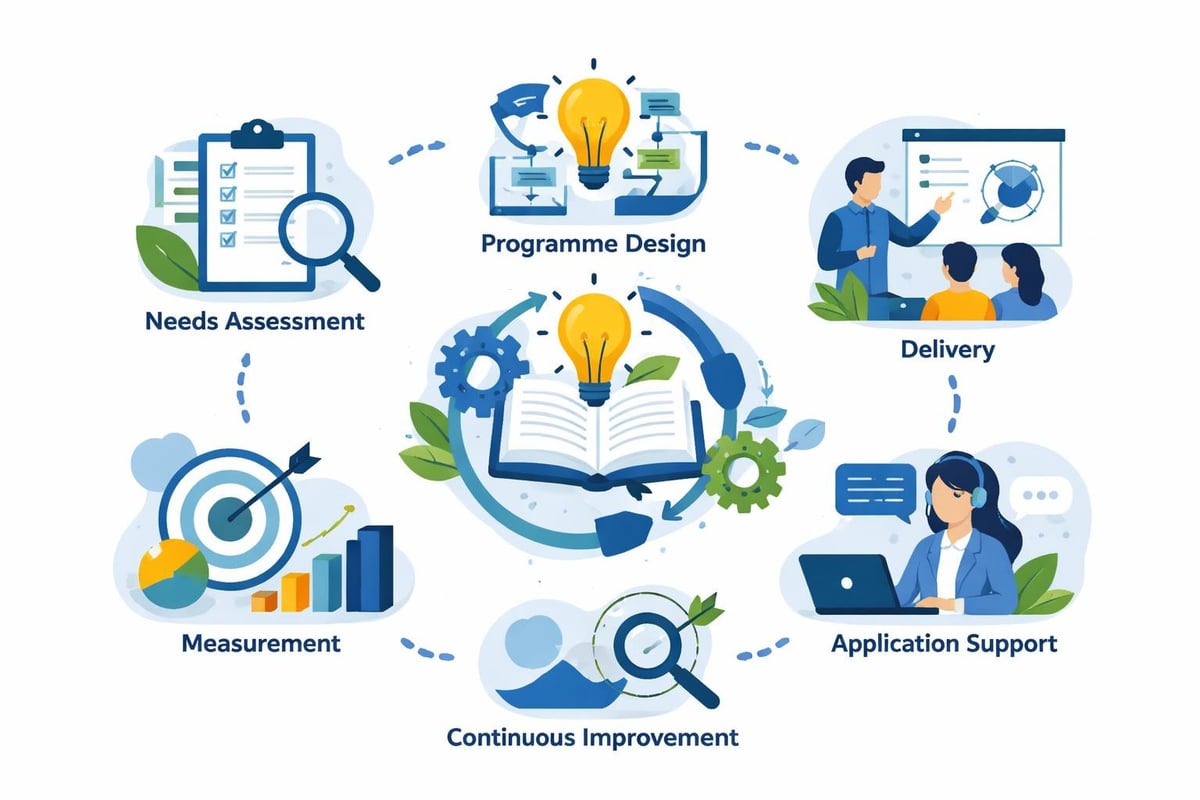
Creating formal development plans for each employee establishes clear expectations and accountability for growth. These plans should identify skill gaps, outline training activities, and define success measures. Regular review conversations between employees and managers ensure plans remain relevant and progress stays on track.
Learning pathways provide structured development progressions for different roles and career trajectories. Rather than random training selection, pathways guide employees through sequences of courses that build competencies systematically. For example, a leadership pathway might begin with foundational supervision skills, progress through intermediate management topics, and culminate in strategic leadership programmes.
Knowledge transfer mechanisms extend training value beyond initial participants. Encourage attendees to share key learnings with their teams through brief presentations, discussion sessions, or written summaries. This multiplication effect spreads knowledge throughout the organization whilst reinforcing learning for initial participants.
Supporting Application and Reinforcement
Training attendance alone doesn't guarantee behaviour change. Organizations must create supportive environments where employees can practice new skills, receive feedback, and refine their approaches.
- Manager involvement in pre-training preparation and post-training follow-up significantly increases application rates
- Peer accountability groups provide ongoing support and encouragement for implementing new practices
- Refresher sessions scheduled 30-90 days after initial training reinforce key concepts and address application challenges
- Recognition programmes that acknowledge and reward skill application motivate continued growth
The most successful corporate training saskatoon programmes view learning as an ongoing process rather than discrete events, creating systems that support continuous improvement.
Budgeting and Planning for Training Investments
Strategic training requires adequate budget allocation and thoughtful planning. Organizations that view training as an investment rather than an expense achieve better results and maintain stronger commitment during challenging economic periods.
Annual training budgets should reflect organizational priorities, employee development needs, and strategic initiatives. Many organizations allocate training budgets as percentages of payroll, typically ranging from one to five percent depending on industry, growth stage, and competitive dynamics.
Maximizing Training ROI
| Strategy | Impact | Implementation |
|---|---|---|
| Needs-based selection | Ensures relevance | Conduct assessments before selecting programmes |
| Group training | Reduces per-person costs | Train teams together when appropriate |
| Virtual delivery | Eliminates travel expenses | Use video conferencing for applicable topics |
| Custom programmes | Increases application | Tailor content to organizational context |
| Internal champions | Extends value | Develop trainer capabilities within organization |
Smart budgeting balances immediate needs with long-term capability building. Whilst responding to urgent skill gaps, also invest in foundational competencies that support sustained performance and adaptability.
Consider training frequency when planning budgets. Some skills, like software proficiency or regulatory compliance, require regular updates. Others, like foundational conflict resolution skills, deliver lasting value from single comprehensive programmes.
Navigating Remote and Hybrid Training Delivery
The shift toward remote work has transformed corporate training saskatoon delivery models. Organizations now routinely blend in-person, virtual synchronous, and asynchronous learning to create flexible, accessible development opportunities.
Virtual instructor-led training combines the engagement of live instruction with the convenience of remote participation. Skilled facilitators use polls, breakout rooms, chat discussions, and collaborative documents to maintain energy and interaction throughout virtual sessions. When delivered effectively, virtual training achieves learning outcomes comparable to in-person delivery whilst offering significant logistical advantages.
Best practices for virtual training emphasize the importance of technology comfort, interactive design, and shorter session durations. Breaking full-day workshops into multiple shorter sessions accommodates remote work realities whilst maintaining engagement and retention.
Hybrid approaches combine delivery methods to optimize learning experiences. For example, a leadership development programme might include virtual instructor-led foundational sessions, in-person experiential workshops for practicing difficult conversations, and on-demand video modules for reinforcing key concepts.
Organizations should invest in reliable technology infrastructure to support virtual training. Quality video conferencing platforms, stable internet connectivity, and appropriate hardware ensure technical issues don't undermine learning experiences. Consider providing technology support resources for participants unfamiliar with virtual collaboration tools.
Emerging Trends in Corporate Training
Forward-thinking organizations monitor emerging corporate training saskatoon trends to stay ahead of evolving workforce development practices. Several significant trends are reshaping how organizations approach employee learning and development.
Microlearning delivers training in short, focused bursts rather than lengthy sessions. This approach accommodates busy schedules, improves retention through spaced repetition, and allows learners to access exactly the information they need when they need it. Effective microlearning strategies combine brief learning modules with practical application exercises.
Skills-based development focuses on building specific competencies rather than completing generic courses. Organizations identify critical skills for success in various roles, then create development pathways that build these capabilities systematically. This targeted approach ensures training investments directly support business needs.
Data-driven personalization uses learning analytics and assessments to tailor development recommendations for individual employees. Rather than prescribing identical training for everyone in a role, personalized approaches account for existing strengths, development areas, learning preferences, and career aspirations.
Social and collaborative learning recognizes that employees learn significantly from peers and practical experience. Training programmes increasingly incorporate group projects, peer coaching, mentoring relationships, and knowledge-sharing platforms alongside formal instruction.
These trends don't replace traditional instructor-led training but rather complement it, creating more comprehensive and effective development ecosystems.
Investing in corporate training saskatoon solutions positions your organization for sustained success through enhanced capabilities, improved performance, and stronger employee engagement. Whether you need specialized technical training, leadership development, or comprehensive soft skills programmes, partnering with an experienced provider ensures your team receives high-quality instruction tailored to your specific needs. My Training Network delivers expert-led training to organizations across Canada, offering over 150 customizable courses designed to drive measurable results for your Saskatoon team.

