

Vancouver's dynamic business environment demands a workforce equipped with contemporary skills and adaptive capabilities. Organizations across British Columbia's largest city increasingly recognize that investing in employee development isn't merely a benefit-it's a competitive necessity. Corporate training vancouver initiatives have evolved significantly, moving beyond traditional classroom settings to embrace hybrid models that combine in-person expertise with virtual accessibility. Whether your organization operates in technology, healthcare, finance, or manufacturing, strategic training programmes create measurable improvements in productivity, employee retention, and organizational agility.
The Vancouver Corporate Training Landscape in 2026
Vancouver's corporate training sector reflects the city's diverse economic landscape. From established institutions to specialized training providers, organizations have unprecedented access to learning solutions tailored for specific industry requirements.
The market has matured considerably over recent years. Companies now seek training partners who understand regional business challenges whilst delivering world-class content. BCIT offers customizable corporate training solutions across sectors like aerospace, automotive, marine, and motive power, demonstrating how established institutions adapt to corporate needs.
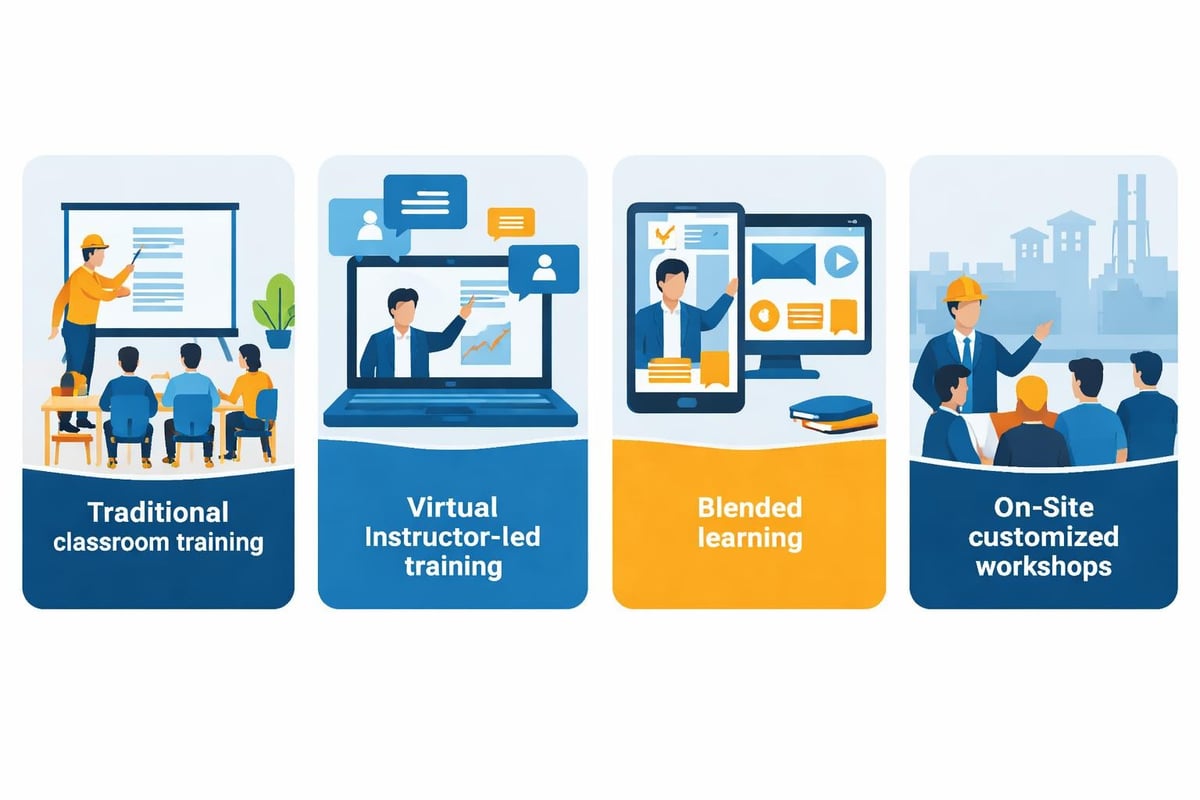
Key trends shaping corporate training vancouver programmes include:
- Hybrid delivery models combining virtual and in-person sessions
- Microlearning modules designed for busy professionals
- Skills-based training aligned with measurable business outcomes
- Leadership development programmes addressing succession planning
- Compliance training meeting regulatory requirements across industries
Organizations partnering with My Training Network benefit from over 150 customizable courses delivered by expert instructors across Canada, including Vancouver-based teams requiring flexible scheduling and content adaptation.
Industry-Specific Training Requirements
Vancouver's economic diversity means training needs vary considerably across sectors. Technology companies prioritize agile methodologies and project management, whilst healthcare organizations focus on patient communication and regulatory compliance.
Manufacturing firms require technical skills development alongside safety training. Financial services institutions emphasize risk management and customer service excellence. Retail organizations invest heavily in sales techniques and customer experience training.
| Industry Sector | Primary Training Focus | Delivery Preference |
|---|---|---|
| Technology | Agile, Project Management, Leadership | Virtual + Onsite |
| Healthcare | Compliance, Communication, Patient Care | Primarily Onsite |
| Finance | Risk Management, Sales, Regulatory | Hybrid Model |
| Manufacturing | Technical Skills, Safety, Quality Control | Onsite Workshops |
| Retail | Customer Service, Sales, Team Leadership | Flexible Delivery |
This diversity requires training providers to maintain extensive course catalogues whilst offering customization capabilities. Instructor-led training remains particularly effective for complex topics requiring immediate feedback and peer interaction.
Building Effective Leadership Pipelines
Leadership development represents a critical investment for Vancouver organizations facing talent shortages and succession planning challenges. Corporate training vancouver programmes increasingly emphasize leadership capabilities at all organizational levels, not solely executive positions.
Contemporary leadership training addresses authentic challenges facing managers in 2026. Remote team management, inclusive leadership practices, and change navigation form core competencies. NobleProg provides management and leadership training in Vancouver, offering both online and onsite instructor-led courses to develop these essential capabilities.
Developing First-Time Managers
The transition from individual contributor to manager represents one of the most challenging career shifts. Many organizations promote exceptional performers into management without providing adequate preparation.
Structured training for new managers should include:
- Foundational management principles covering delegation, feedback, and performance management
- Communication skills development for difficult conversations and team meetings
- Time management strategies balancing individual work with team responsibilities
- Emotional intelligence training for relationship building and conflict resolution
- Legal and ethical considerations including workplace harassment and accommodation
Organizations investing in leadership skills training programs create stronger management pipelines whilst reducing costly turnover amongst high-potential employees.
Short, focused sessions work better than lengthy programmes. New managers need immediately applicable skills, not theoretical frameworks. Interactive workshops with real scenario practice deliver superior results compared to lecture-based approaches.

Soft Skills Training That Delivers Results
Technical competencies remain essential, yet soft skills increasingly differentiate high-performing organizations from competitors. Corporate training vancouver initiatives now prioritize communication, collaboration, and adaptability alongside role-specific capabilities.
The challenge lies in measuring soft skills development. Unlike technical training with clear competency benchmarks, soft skills improvements require different assessment approaches. Effective programmes combine self-assessment, peer feedback, and observable behavior changes.
Communication Excellence Across Teams
Vancouver's multicultural workforce presents unique communication opportunities and challenges. Teams comprising diverse backgrounds, languages, and communication preferences require intentional skills development.
Communication skills development courses address written communication, presentation skills, active listening, and cross-cultural awareness. Practical exercises allow participants to practice techniques in safe environments before applying them in high-stakes situations.
Key communication competencies include:
- Active listening techniques that improve understanding
- Concise writing for emails, reports, and documentation
- Persuasive presentation skills for proposals and updates
- Difficult conversation management with confidence
- Cross-cultural communication awareness and adaptation
Vancouver Community College delivers practical, accessible training aligned with real workplace challenges, helping organizations adapt and perform effectively through improved communication.
Teams that communicate effectively resolve conflicts faster, innovate more successfully, and demonstrate higher engagement levels. The investment in communication training typically yields returns within months through reduced misunderstandings and improved collaboration.
Navigating Organizational Change Successfully
Vancouver organizations face constant change pressures: technological disruption, market shifts, regulatory updates, and competitive threats. Corporate training vancouver programmes increasingly incorporate change management capabilities to help teams navigate transitions effectively.
Change initiatives fail most often due to people factors, not strategic or technical issues. Employees resist changes they don't understand or fear will disadvantage them. Effective training equips leaders and team members with frameworks for processing and adapting to change.
NobleProg offers change management training in Vancouver, focusing on interactive discussions and hands-on practice to navigate organizational changes effectively through structured methodologies.
Building Change Resilience
Change resilience differs from simple resistance reduction. Resilient teams anticipate change, adapt quickly, and identify opportunities within disruption. Training programmes should develop both individual and collective capabilities.
| Change Competency | Individual Development | Team Development |
|---|---|---|
| Anticipation | Environmental scanning, trend awareness | Scenario planning, risk assessment |
| Adaptation | Flexibility, learning agility | Collaborative problem-solving |
| Communication | Transparent dialogue, feedback seeking | Information sharing, collective sense-making |
| Innovation | Creative thinking, experimentation | Cross-functional collaboration, rapid prototyping |
Organizations can strengthen change capabilities through training workshops that simulate realistic scenarios requiring rapid adaptation and collaborative problem-solving under pressure.
Resilience training proves particularly valuable during major transitions: mergers and acquisitions, technology implementations, restructuring initiatives, or market repositioning. Teams prepared for change execute transitions more smoothly with less productivity disruption.
Technical Training for Evolving Skill Requirements
Vancouver's technology sector growth creates continuous demand for technical skills development. Organizations must balance maintaining current system competencies whilst preparing teams for emerging technologies and methodologies.
Corporate training vancouver technical programmes span diverse topics: software development frameworks, data analytics, cybersecurity, cloud computing, and artificial intelligence applications. The rapid pace of technological change means course content requires frequent updates.

Effective technical training combines theoretical understanding with practical application. Participants need hands-on practice with real tools and systems, not merely conceptual overviews. Lab environments, sandbox systems, and project-based learning deliver superior outcomes.
Balancing Depth and Breadth
Organizations face difficult decisions regarding technical training scope. Should employees develop deep expertise in specific technologies or broader familiarity across multiple systems?
The optimal approach depends on organizational strategy and role requirements. Specialists benefit from deep-dive technical courses building advanced capabilities. Generalists need broader exposure enabling effective collaboration across technical domains.
Technical training delivery considerations:
- Prerequisites and skill levels ensuring appropriate course placement
- Hands-on practice time for skill reinforcement and confidence building
- Real-world scenarios connecting training content to actual work challenges
- Post-training support through resources, mentoring, and follow-up sessions
- Certification opportunities validating competency achievement
Organizations leveraging virtual workshops expand technical training access beyond geographical constraints whilst maintaining interactive learning experiences through skilled facilitation and collaborative tools.
Compliance and Governance Training Essentials
Regulatory requirements create non-negotiable training needs across industries. Vancouver organizations must ensure employees understand workplace safety, privacy regulations, anti-harassment policies, and industry-specific compliance requirements.
Compliance training often suffers from poor engagement. Employees view mandatory sessions as box-ticking exercises rather than valuable learning opportunities. Effective programmes transform compliance training from obligation to capability development.
NobleProg provides corporate governance training in Vancouver, covering fundamentals and advanced topics to enhance governance capabilities through interactive and practical approaches.
Creating Engaging Compliance Programmes
The challenge lies in making essential but potentially dry content engaging and memorable. Scenario-based learning, case studies from real incidents, and interactive discussions dramatically improve retention compared to lecture-based approaches.
Consider these strategies for compliance training enhancement:
- Use real case studies from your industry (anonymized appropriately)
- Incorporate interactive scenarios requiring decision-making
- Facilitate discussions about grey areas and ethical dilemmas
- Provide job aids and reference materials for ongoing use
- Schedule refresher sessions maintaining awareness over time
- Connect compliance requirements to organizational values and culture
Corporate compliance training focusing on interactive discussions and hands-on practice helps organizations meet regulatory obligations whilst developing genuine understanding rather than superficial awareness.
Compliance failures create significant risks: financial penalties, reputational damage, legal liability, and operational disruptions. Investment in quality compliance training represents risk mitigation with clear return on investment.
Measuring Training Effectiveness and ROI
Vancouver organizations increasingly demand evidence that corporate training delivers measurable value. Training investment represents significant expense, requiring justification through demonstrated business impact.
The Kirkpatrick Model provides a widely accepted framework for training evaluation across four levels: reaction, learning, behavior, and results. Each level requires different measurement approaches and provides distinct insights.
Training evaluation framework:
| Level | Measurement Focus | Assessment Methods | Timeline |
|---|---|---|---|
| Reaction | Participant satisfaction | Post-session surveys, feedback forms | Immediate |
| Learning | Knowledge acquisition | Tests, assessments, demonstrations | During/immediately after |
| Behavior | On-job application | Observations, 360 feedback, performance metrics | 30-90 days post-training |
| Results | Business impact | KPIs, productivity, quality, retention | 90+ days post-training |
Organizations working with expert trainers should establish clear success metrics before programme delivery, enabling meaningful evaluation against specific objectives rather than generic satisfaction measures.
Connecting Training to Business Outcomes
The most compelling training ROI demonstrates connections to strategic business objectives. Reduced customer complaints following service training, decreased safety incidents after compliance programmes, or improved sales conversion rates after negotiation workshops provide concrete evidence of value.
Establishing these connections requires advance planning. Organizations must identify baseline metrics before training, isolate training impact from other variables, and track changes over sufficient timeframes for meaningful patterns to emerge.
Qualitative evidence complements quantitative metrics. Employee testimonials, manager observations, and customer feedback provide context explaining numerical changes whilst highlighting unexpected benefits.
Customization and Flexibility in Training Delivery
Vancouver's diverse organizational landscape means one-size-fits-all training rarely delivers optimal results. Corporate training vancouver providers increasingly emphasize customization capabilities, adapting content, examples, and delivery methods to specific organizational contexts.
Customization operates on multiple levels. Content modification addresses industry-specific scenarios and terminology. Delivery timing accommodates operational constraints and scheduling preferences. Format selection matches learning preferences and practical constraints.
Tailored training approaches begin with thorough needs assessment, identifying specific skill gaps, business challenges, and desired outcomes before designing programme content and delivery strategies.
Designing Custom Training Solutions
Effective customization requires genuine partnership between training providers and client organizations. Surface-level modifications-simply changing company names in generic materials-provide minimal value compared to substantive content adaptation.
The customization process should include:
- Stakeholder interviews understanding business context and strategic priorities
- Skills gap analysis identifying specific development needs across roles
- Learning objectives alignment connecting training to measurable business outcomes
- Content development collaboration incorporating organizational examples and scenarios
- Pilot testing refining materials based on initial delivery feedback
- Ongoing refinement adjusting content as organizational needs evolve
Organizations exploring company training programs should evaluate providers based on customization capabilities, not merely course catalogue breadth or pricing structures.
Customized programmes demonstrate superior engagement and application compared to generic alternatives. Employees recognize content relevance to their actual work challenges, increasing motivation and knowledge transfer.
Virtual and Hybrid Training Models
The acceleration of virtual training during recent years has permanently transformed corporate training vancouver delivery models. Organizations now expect training providers to offer flexible options: fully virtual, traditional in-person, or hybrid combinations.
Virtual training eliminates geographical barriers whilst reducing costs associated with travel, venue rental, and participant time away from work. However, virtual delivery requires different facilitation skills and technological capabilities compared to traditional classroom training.
Online courses delivered through skilled facilitation maintain engagement through interactive elements: breakout discussions, collaborative exercises, polling, and real-time problem-solving rather than passive lecture consumption.
Maximizing Virtual Training Effectiveness
Virtual training success depends on intentional design and skilled facilitation. Simply replicating in-person sessions via video conference produces suboptimal results. Effective virtual programmes leverage technology capabilities whilst acknowledging constraints.
Virtual training best practices include:
- Sessions limited to 90-120 minutes maximum before breaks
- Interactive elements every 10-15 minutes maintaining engagement
- Breakout rooms for small group discussions and exercises
- Visual content supporting verbal explanations
- Pre-work and post-session assignments extending learning
- Technical support readily available for participant issues
Hybrid models combine virtual and in-person elements, potentially offering optimal flexibility. Core content delivery might occur virtually whilst hands-on practice, networking, or sensitive discussions happen during in-person sessions.
Building Continuous Learning Cultures
Single training events rarely create lasting capability development. Organizations achieving sustainable performance improvements embed learning into daily operations, creating cultures where continuous development represents normal practice rather than occasional intervention.
Corporate training vancouver initiatives increasingly focus on building learning ecosystems rather than delivering isolated programmes. This approach combines formal training, informal learning opportunities, coaching, mentoring, and knowledge-sharing platforms.
Leadership commitment proves essential for learning culture development. When executives visibly prioritize their own development and celebrate team learning achievements, employees recognize that capability building represents genuine organizational priority rather than superficial rhetoric.
Sustaining Learning Beyond Training Events
The challenge lies in maintaining momentum after formal training concludes. Without reinforcement and application opportunities, newly acquired knowledge and skills fade rapidly-often within weeks of programme completion.
Organizations can sustain learning through multiple mechanisms:
- Action learning projects applying new skills to real business challenges
- Peer learning groups sharing experiences and problem-solving collectively
- Coaching support providing individualized guidance during skill application
- Knowledge repositories capturing insights and best practices for ongoing reference
- Recognition programmes celebrating learning achievements and capability development
- Regular refreshers reinforcing key concepts and updating skills
Training and professional development programmes designed with sustainability in mind incorporate these elements from inception rather than treating them as afterthoughts following initial delivery.
Organizations investing in learning cultures demonstrate higher innovation rates, stronger employee engagement, improved retention of high performers, and greater adaptability to market changes compared to competitors treating training as occasional compliance necessity.
Corporate training vancouver programmes must address diverse organizational needs whilst delivering measurable business impact through customized, engaging learning experiences. Success requires strategic planning, skilled facilitation, and sustained commitment extending beyond initial programme delivery. Whether your team requires leadership development, technical skills enhancement, or soft skills training, My Training Network delivers expert, customizable solutions across Canada and globally-helping organizations build the capabilities needed to thrive in 2026's competitive landscape.

