

Customer experience has emerged as the defining competitive advantage for organizations across every industry. In 2026, businesses that prioritize exceptional service delivery consistently outperform their competitors, earning higher customer loyalty, stronger retention rates, and increased revenue. The foundation of this success lies in comprehensive customer experience training that equips teams with the skills, mindset, and tools to deliver outstanding interactions at every touchpoint. For Canadian organizations seeking to elevate their service standards, investing in structured training programs has become essential rather than optional.
Why Customer Experience Training Matters More Than Ever
The expectations customers hold for service quality have reached unprecedented heights. With instant access to reviews, social media platforms, and alternative providers, dissatisfied customers can easily take their business elsewhere. Modern consumers demand personalized, efficient, and empathetic service across all channels.
Organizations that implement robust customer experience training programs see measurable improvements across key performance indicators. These benefits extend far beyond customer satisfaction scores:
- Reduced employee turnover through increased confidence and job satisfaction
- Higher first-contact resolution rates as teams handle issues more effectively
- Improved brand reputation leading to positive word-of-mouth referrals
- Increased revenue from repeat customers and upselling opportunities
- Lower service costs through more efficient problem resolution
Research from customer service experts demonstrates that training contact center agents in customer experience requires scenario-based learning and real-time support tools. This approach ensures teams can apply their knowledge when it matters most.

Essential Components of Effective Customer Experience Training
Building a comprehensive training program requires careful attention to multiple skill areas. The most successful initiatives address both technical competencies and emotional intelligence capabilities.
Communication Skills Development
Strong communication forms the backbone of exceptional customer experiences. Communication training programs should cover verbal, written, and non-verbal communication techniques. Teams need to master active listening, empathy expression, and clear articulation of solutions.
Key communication elements include:
- Active listening techniques that demonstrate genuine interest
- Empathy statements that validate customer concerns
- Clear language that avoids jargon and confusion
- Positive framing that focuses on solutions
- Tone management across different channels
Problem-Solving and Critical Thinking
Customer-facing employees encounter unique challenges daily. Training must prepare them to think critically, analyze situations quickly, and develop creative solutions. This includes understanding when to follow procedures and when to escalate issues appropriately.
| Skill Area | Training Focus | Business Impact |
|---|---|---|
| Decision Making | Empowerment frameworks and guidelines | Faster resolution times |
| Root Cause Analysis | Identifying underlying issues | Reduced repeat contacts |
| Creative Solutions | Thinking beyond scripts | Enhanced satisfaction |
| Resource Navigation | Finding information quickly | Improved efficiency |
Product and Service Knowledge
Deep understanding of offerings enables teams to provide accurate information and identify opportunities to enhance customer value. This knowledge should extend beyond basic features to include use cases, competitive advantages, and integration possibilities.
Designing Customer Experience Training Programs
Creating effective training requires strategic planning and ongoing refinement. Organizations must balance standardization with flexibility to address diverse team needs and learning styles.
Needs Assessment and Goal Setting
Before developing content, conduct thorough assessments to identify current skill gaps and future requirements. Engage frontline employees, managers, and customers in this discovery process to gather comprehensive insights.
Define specific, measurable objectives for your customer experience training initiative. Rather than vague goals like "improve service," target concrete outcomes such as "increase customer satisfaction scores by 15% within six months" or "reduce average handle time by 20% while maintaining quality."
Tailoring Content to Different Roles
Not all customer-facing positions require identical training. Segment your program based on role-specific responsibilities and customer interaction types. Leadership training for supervisors should emphasize coaching and performance management, while frontline staff need deeper operational skills.
Role-based training segments:
- Frontline service representatives
- Technical support specialists
- Sales and account management teams
- Social media and digital support staff
- Escalation and retention specialists
Blending Learning Methods
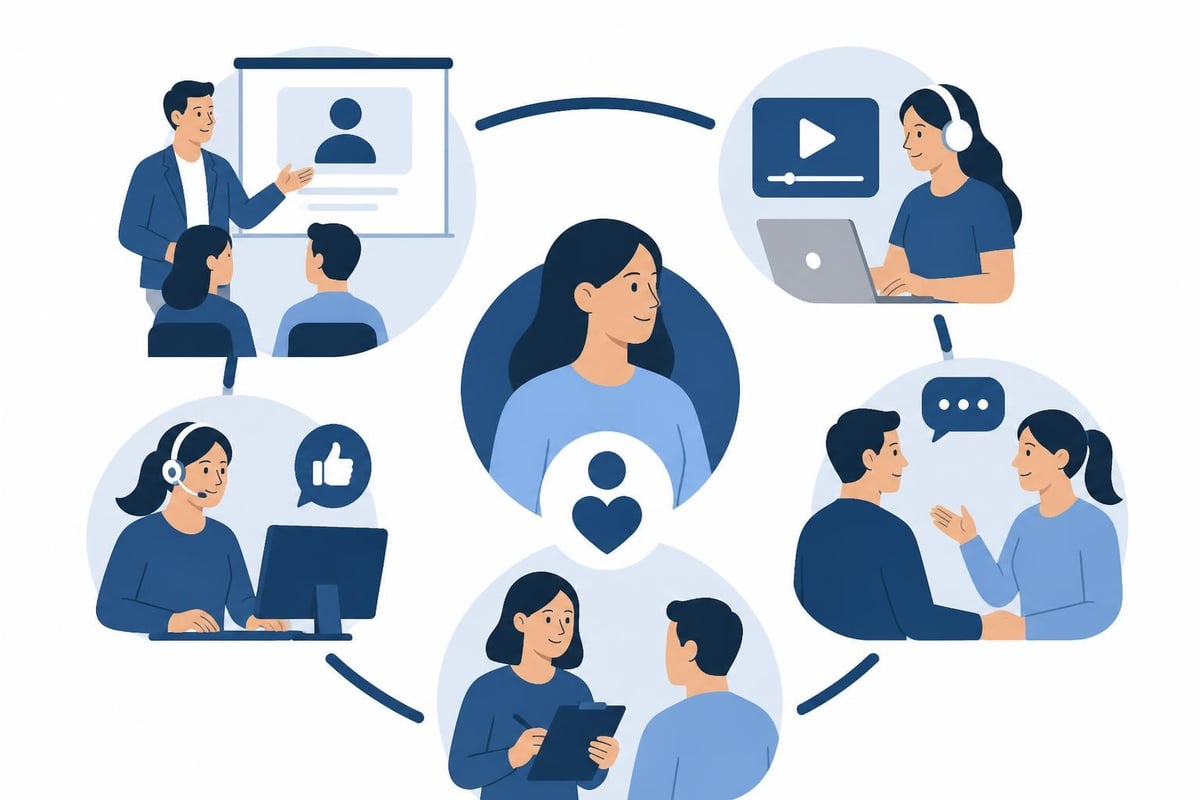
The most effective customer experience training programs utilize multiple delivery methods to accommodate different learning preferences and reinforce key concepts. According to customer training best practices, engaging educational experiences boost product adoption and satisfaction.
Combine instructor-led workshops with self-paced digital modules, role-playing exercises, shadowing opportunities, and continuous coaching. This blended approach ensures knowledge retention and practical application.
Best Practices for Implementation Success
Launching a training program represents just the beginning. Sustained success requires careful execution and ongoing support throughout the employee journey.
Creating Engaging Learning Experiences
Adult learners respond best to practical, relevant content that connects directly to their daily responsibilities. Incorporate real customer scenarios, case studies from your industry, and interactive simulations that mirror actual situations teams will encounter.
Instructor-led training provides invaluable opportunities for discussion, questions, and peer learning. Expert trainers can adapt content in real-time based on participant needs and share insights from diverse organizational contexts.
Reinforcement and Continuous Learning
Single training events rarely produce lasting behaviour change. Build reinforcement mechanisms into your program structure:
- Microlearning modules delivered weekly to refresh key concepts
- Team huddles that discuss recent customer interactions and lessons learned
- Coaching sessions providing personalized feedback and development
- Knowledge bases offering just-in-time information access
- Refresher workshops conducted quarterly or semi-annually
Measurement and Optimization
Track both leading and lagging indicators to evaluate your customer experience training effectiveness. Leading indicators include training completion rates, assessment scores, and confidence levels. Lagging indicators encompass customer satisfaction metrics, retention rates, and service quality scores.
| Metric Type | Examples | Measurement Frequency |
|---|---|---|
| Training Activity | Completion rates, time to competency | Weekly |
| Employee Confidence | Self-assessments, manager observations | Monthly |
| Service Quality | Quality assurance scores, compliance | Weekly |
| Customer Outcomes | Satisfaction, effort scores, retention | Monthly |
| Business Results | Revenue, cost per contact, lifetime value | Quarterly |
The insights gathered from comprehensive customer training programs should inform continuous improvements to content, delivery methods, and support resources.
Addressing Common Training Challenges
Organizations frequently encounter obstacles when implementing customer experience training initiatives. Anticipating these challenges enables proactive solution development.
Time and Resource Constraints
Balancing training needs with operational demands creates tension in many organizations. Teams worry about coverage gaps during training sessions, while budget limitations may restrict program scope.
Address these concerns through flexible scheduling options, condensed intensive formats, and clear ROI demonstrations. Time management training can help both employees and managers optimize their schedules to accommodate development activities.
Technology and Omnichannel Complexity
Modern customer service spans multiple channels, each with unique dynamics and expectations. Understanding what omnichannel customer service means helps organizations develop training that addresses seamless support delivery across platforms.
Train teams to maintain consistent service quality whether interacting via phone, email, chat, social media, or in-person. Each channel requires specific technical skills while upholding universal service principles.
Resistance to Change
Some employees may resist new training initiatives, particularly if they feel current approaches work adequately. Build buy-in through transparent communication about program benefits, involvement in design processes, and recognition of training achievements.
Share success stories and data demonstrating positive outcomes from customer experience training. When teams see colleagues succeeding and receiving positive feedback, adoption accelerates.

Specialized Training for Different Industries
While core customer experience principles apply universally, industry-specific nuances require tailored approaches. Organizations benefit from customizing training content to reflect their unique operational contexts and customer expectations.
Service Industry Applications
Hospitality, retail, and personal service sectors face intense competition based largely on experience quality. Training should emphasize emotional intelligence, personalization techniques, and recovery strategies when things go wrong.
Technical Support and B2B Contexts
Complex product environments and longer customer relationships characterize business-to-business interactions. Training must balance technical expertise with relationship-building skills, often requiring deeper product knowledge and consultative selling capabilities.
Healthcare and Regulated Environments
Industries with strict compliance requirements need customer experience training that integrates regulatory knowledge seamlessly. Teams must deliver compassionate service while adhering to privacy rules, documentation standards, and ethical guidelines.
Building a Culture of Customer-Centricity
The most impactful customer experience training extends beyond skill development to foster organizational culture transformation. When customer focus becomes embedded in company values and daily operations, exceptional service becomes sustainable.
Leadership Alignment and Modeling
Executives and managers must visibly champion customer-centric behaviours. New manager training should include modules on coaching customer experience excellence and recognizing outstanding service delivery.
Leaders who actively participate in training, share customer feedback, and hold teams accountable for experience standards create powerful cultural signals. Their actions demonstrate that customer experience represents a strategic priority rather than a compliance exercise.
Recognition and Reward Systems
Align performance management and incentive programs with customer experience objectives. Celebrate employees who demonstrate exceptional service, solve difficult problems creatively, or receive outstanding customer feedback.
Effective recognition approaches include:
- Monthly service excellence awards with specific criteria
- Peer nomination programs highlighting collaborative support
- Customer testimonial sharing in team meetings
- Career advancement pathways emphasizing service skills
- Performance bonuses tied to satisfaction metrics
Empowerment and Autonomy
Training loses effectiveness when employees lack authority to act on their knowledge. Establish clear empowerment guidelines that enable teams to resolve issues, offer appropriate compensation, and make judgment calls within defined parameters.
Organizations like American Airlines have demonstrated how elevating everyday customer experiences through training improves both service consistency and employee engagement when combined with appropriate decision-making authority.
Leveraging Technology in Customer Experience Training
Digital tools and platforms expand training possibilities while enabling scalability and consistency across distributed teams. The strategic integration of technology enhances learning outcomes without replacing human connection.
Learning Management Systems
Centralized platforms streamline content delivery, progress tracking, and certification management. These systems enable self-paced learning, assessment administration, and reporting capabilities that inform program optimization.
Virtual and Augmented Reality
Immersive technologies create realistic practice environments where employees can develop skills without risk to actual customer relationships. Virtual reality simulations replicate challenging scenarios, allowing teams to build confidence through repetition.
AI and Adaptive Learning
Artificial intelligence applications personalize learning pathways based on individual performance, knowledge gaps, and role requirements. Adaptive systems focus training time on areas needing improvement while advancing quickly through mastered content.
Recent research on Agentic AI deployment in customer support demonstrates measurable improvements in both agent efficiency and customer experience when technology augments human capabilities rather than replacing them.
Developing Internal Training Capacity
While external expertise provides valuable perspectives, building internal training capabilities ensures sustainability and organizational knowledge retention. Many companies benefit from hybrid approaches combining outside facilitation with internal subject matter expertise.
Train-the-Trainer Programs
Develop internal champions who can deliver customer experience training to their peers. These programs should cover both content expertise and facilitation skills, ensuring trainers can engage audiences effectively.
Coaching skills for managers training prepares leaders to provide ongoing development support between formal training sessions, creating a continuous learning environment.
Knowledge Capture and Documentation
Systematically document customer interaction insights, successful resolution techniques, and evolving best practices. This organizational knowledge becomes training content that reflects real-world situations and proven approaches.
Partnerships with Training Providers
Collaborating with specialized training organizations provides access to broader expertise, proven methodologies, and customizable content. The right partner brings fresh perspectives while tailoring programs to specific organizational needs and industry contexts.
Measuring Return on Investment
Demonstrating the business value of customer experience training secures ongoing support and resources. Comprehensive measurement approaches connect training activities to tangible business outcomes.
Financial Impact Analysis
Calculate revenue retention from improved customer loyalty, cost savings from reduced escalations and repeat contacts, and revenue growth from enhanced upselling capabilities. Compare these benefits against program costs to establish clear ROI.
Customer Lifetime Value Improvements
Track changes in customer lifetime value following training implementation. Customers who receive better service typically purchase more frequently, spend more per transaction, and remain loyal longer.
Employee Metrics
Monitor turnover rates, engagement scores, and internal promotion rates among trained versus untrained populations. Quality customer experience training often improves employee satisfaction alongside customer outcomes.
| ROI Component | Calculation Method | Typical Impact Range |
|---|---|---|
| Retention Revenue | Saved customers × average value | 10-25% improvement |
| Efficiency Gains | Reduced handle time × volume × cost | 15-30% reduction |
| Upsell Revenue | Conversion rate increase × opportunity value | 8-20% growth |
| Turnover Costs | Reduced replacement costs × positions saved | 20-40% decrease |
Future Trends in Customer Experience Training
The customer experience landscape continues evolving rapidly. Forward-thinking organizations prepare their teams for emerging expectations and interaction models.
Personalization at Scale
Customers increasingly expect individualized experiences that acknowledge their history, preferences, and needs. Training must equip teams to leverage customer data effectively while maintaining authentic human connection.
Emotional Intelligence Enhancement
As routine transactions become automated, human interactions increasingly focus on complex, emotionally charged situations. Developing empathy, emotional regulation, and relationship-building capabilities becomes paramount.
Sustainability and Values Alignment
Customers gravitate toward organizations whose values align with their own. Training should help teams articulate company commitments to sustainability, diversity, and social responsibility while delivering on these promises through service behaviours.
Customer experience training represents one of the most impactful investments organizations can make in 2026, directly influencing satisfaction, loyalty, and revenue outcomes. By implementing comprehensive programs that develop communication skills, problem-solving abilities, and customer-centric mindsets, companies position themselves for sustainable competitive advantage. My Training Network specializes in delivering customizable training solutions that transform customer-facing teams across Canada and beyond, combining expert instruction with practical application to drive measurable results for your organization.

