

Exceptional customer service doesn't happen by accident. It's the result of deliberate, well-structured training that equips teams with the skills, knowledge, and confidence to handle every interaction with professionalism. In today's competitive landscape, businesses that invest in robust customer service training programs gain a significant advantage, building loyalty, reducing churn, and creating advocates who amplify their brand. Whether you're supporting a global client base or serving local communities across Canada, the quality of your customer service training directly impacts your organisation's reputation and bottom line.
The Business Case for Structured Training
Customer service teams represent the frontline of your organisation, often serving as the only human touchpoint customers experience. Poorly trained staff create friction, frustration, and failed relationships. Conversely, well-trained teams turn challenging situations into opportunities, transforming dissatisfied customers into loyal promotions.
Research consistently demonstrates that organisations with comprehensive customer service training programs experience higher customer satisfaction scores, improved employee retention, and increased revenue per customer. Training isn't simply an operational expense; it's a strategic investment that compounds over time.
Quantifiable Training Outcomes
When evaluating training effectiveness, organisations should track specific metrics:
- First-contact resolution rates – indicating how often issues are solved immediately
- Average handle time – measuring efficiency without sacrificing quality
- Customer satisfaction scores (CSAT) – reflecting overall service quality
- Net Promoter Score (NPS) – gauging customer loyalty and likelihood to recommend
- Employee engagement levels – showing team confidence and job satisfaction
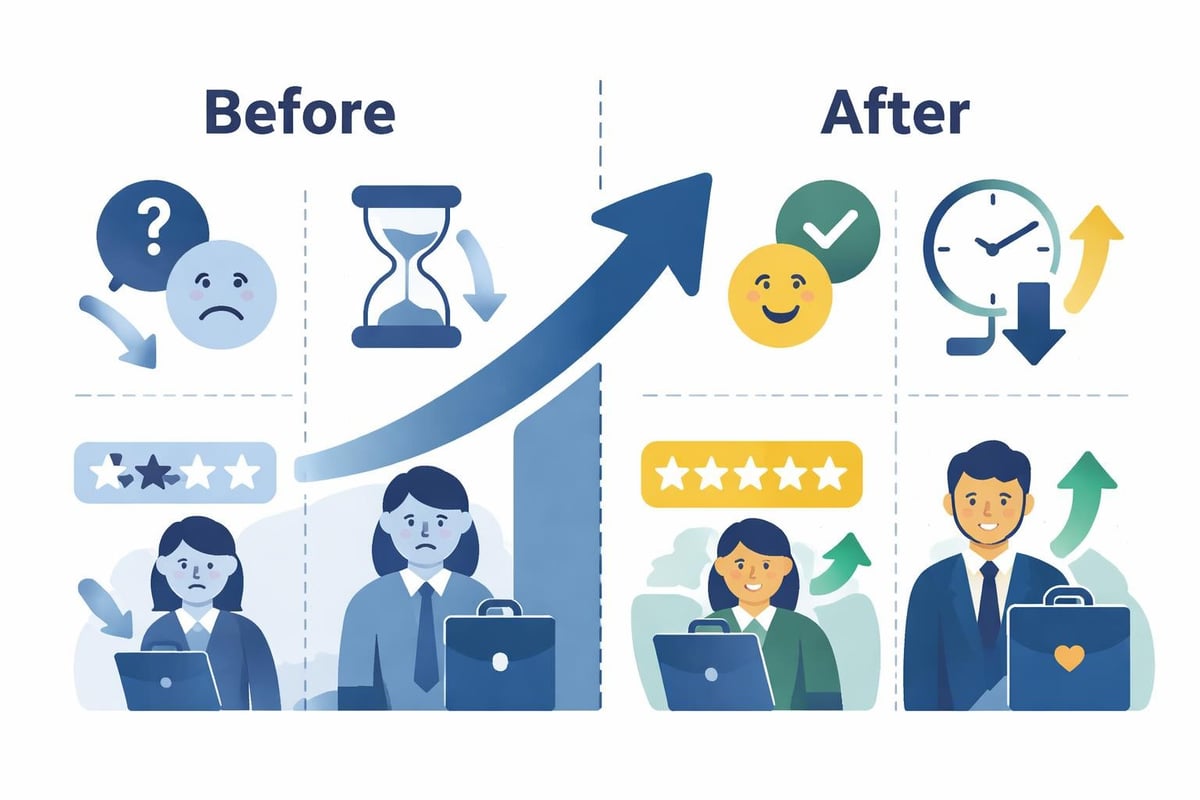
| Metric | Before Training | After Training | Improvement |
|---|---|---|---|
| First-contact resolution | 65% | 82% | +17% |
| Average handle time | 8.5 min | 6.2 min | -27% |
| CSAT score | 72% | 89% | +17 points |
| Employee turnover | 35% | 18% | -49% |
These improvements directly translate to reduced operational costs, higher customer lifetime value, and stronger competitive positioning.
Core Components of Effective Training
Building a successful customer service training program requires careful attention to both technical competencies and interpersonal skills. The most effective programmes balance hard skills with soft skills, creating well-rounded professionals who can navigate complex situations.
Product and Service Knowledge
Representatives cannot provide exceptional service without deep understanding of what they're supporting. Comprehensive product training should cover:
- Feature functionality – how products work and common use cases
- Troubleshooting protocols – systematic approaches to problem identification
- Integration points – how products connect with other systems
- Limitation awareness – honest understanding of what products cannot do
- Roadmap visibility – upcoming features and improvements
This knowledge foundation enables confident, accurate responses that build customer trust. According to Salesforce’s customer service training insights, product knowledge ranks among the most valuable training subjects for any customer-facing team.
Communication Excellence
Technical knowledge means little without the ability to convey information clearly and empathetically. Communication training should emphasise:
Verbal communication skills including tone modulation, pacing, and clarity. Representatives learn to adjust their communication style to match customer preferences, whether that means simplifying technical concepts or providing detailed explanations.
Written communication proficiency for email, chat, and documentation. Clear, professional writing prevents misunderstandings and provides customers with valuable reference materials. For organisations looking to strengthen written communication across all teams, business writing skills training can provide valuable foundations.
Active listening techniques that ensure customers feel heard and understood. This means asking clarifying questions, paraphrasing to confirm understanding, and identifying unstated needs. The active listening course from My Training Network specifically addresses these crucial competencies.
Emotional Intelligence and Empathy
Perhaps no skill matters more in customer service than the ability to recognise, understand, and respond appropriately to emotions. Customer service training programs must develop emotional intelligence through:
- Perspective-taking exercises that build genuine empathy
- Stress management techniques for high-pressure situations
- Emotional regulation strategies when facing difficult customers
- Recognition of emotional cues in voice, language, and behaviour
Organisations investing in emotional intelligence in the workplace training see measurable improvements in customer satisfaction and team morale.
Training Delivery Methods and Approaches
How you deliver training matters as much as what you teach. Modern customer service training programs leverage multiple methodologies to accommodate different learning styles and operational constraints.
Instructor-Led Training
Traditional classroom or virtual instructor-led sessions remain highly effective for complex topics requiring discussion, role-play, and immediate feedback. These sessions excel at building team cohesion and allowing learners to practice skills in safe environments.
Benefits include real-time adaptation to learner needs, opportunities for collaborative learning, and the ability to address nuanced questions that pre-recorded content cannot anticipate.
Blended Learning Approaches
Combining self-paced digital modules with live instruction creates flexible, comprehensive programmes. Learners complete foundational content independently, then apply concepts during interactive sessions.
This approach maximises training efficiency while maintaining engagement. According to customer service training best practices, blended learning approaches significantly improve knowledge retention compared to single-method programmes.
On-the-Job Training and Shadowing
Nothing replaces real-world experience. Structured shadowing programmes pair new representatives with experienced mentors, allowing observation of actual customer interactions followed by supervised practice.
Effective shadowing programmes include:
- Clear observation objectives for each session
- Structured debrief discussions highlighting key learnings
- Graduated responsibility as confidence builds
- Regular feedback loops between mentor and learner
- Documentation of competency development

Building Role-Playing Scenarios and Simulations
Theory becomes practical skill through deliberate practice. Customer service training programs should incorporate extensive role-playing that mirrors real situations representatives will encounter.
Scenario Design Principles
Effective scenarios are specific, challenging, and directly relevant to your business context. They should include:
| Scenario Type | Purpose | Example Situation |
|---|---|---|
| Angry customer | De-escalation practice | Product failed during critical business event |
| Complex technical issue | Problem-solving skills | Multi-system integration problem |
| Refund request | Policy application | Customer wants refund outside standard window |
| Upsell opportunity | Revenue generation | Customer needs additional functionality |
| Confused customer | Clarification and education | New user struggling with basic features |
Implementing Effective Role-Play Sessions
Structure role-playing to maximise learning while minimising anxiety. Start with simpler scenarios and progressively increase difficulty as confidence builds.
Provide clear character descriptions for both the representative and the "customer," including emotional state, specific concerns, and desired outcomes. Rotate roles so participants experience both perspectives, building empathy and understanding.
Record and review sessions when possible, allowing participants to observe their own performance objectively. This self-assessment proves remarkably powerful for identifying improvement opportunities.
Addressing Common Service Challenges
Customer service training programs must prepare teams for the most frequent and difficult situations they'll face. Proactive preparation reduces stress and improves outcomes.
Managing Difficult Conversations
Every customer service professional eventually faces angry, frustrated, or unreasonable customers. Training should provide frameworks for these encounters:
- Acknowledge emotions before addressing facts
- Take ownership even when the problem originated elsewhere
- Focus on solutions rather than defending past decisions
- Set clear expectations about what can and cannot be done
- Know escalation triggers for when manager involvement becomes necessary
Understanding effective strategies for tough talks equips representatives with confidence to navigate these challenging interactions.
Handling Multiple Communication Channels
Modern customer service extends across phone, email, chat, social media, and increasingly, messaging platforms. Each channel requires adapted techniques while maintaining consistent service quality.
The concept of omnichannel customer service emphasises seamless transitions between channels, allowing customers to switch without repeating information. Training must address channel-specific best practices while reinforcing core service principles that transcend medium.
Balancing Efficiency with Quality
Representatives face constant tension between resolving issues quickly and providing thorough, personalised service. Training should establish when efficiency takes precedence and when investment in the relationship matters more.
High-value accounts, complex issues, and relationship-building moments justify additional time. Routine inquiries with straightforward solutions benefit from streamlined processes. Teaching this discernment prevents both rushed interactions that damage relationships and unnecessarily prolonged simple requests.
Continuous Learning and Development
Initial training represents just the foundation. Customer service training programs must include ongoing development that keeps skills sharp and knowledge current.
Regular Skill Refreshers
Even experienced representatives benefit from periodic reinforcement of core competencies. Quarterly or bi-annual refresher sessions prevent skill degradation and introduce refined techniques.
These sessions work best when they address observed performance gaps rather than generic content repetition. Analyse support metrics, customer feedback, and quality assurance evaluations to identify specific improvement opportunities.
New Product and Feature Training
Every product update, new feature, or service expansion requires corresponding training. Establish processes ensuring customer service teams learn about changes before customers encounter them.
- Pre-release training for major launches
- Weekly or monthly updates for incremental changes
- Comprehensive documentation teams can reference during interactions
- Testing environments where representatives can explore new features
Advanced Skills Development
Creating career progression pathways keeps talented representatives engaged. Offer advanced training in specialised areas:
- Technical troubleshooting for complex products
- Team leadership and mentoring capabilities
- Customer success and relationship management
- Quality assurance and training delivery
- Process improvement and operational excellence
Organisations offering leadership and management courses internally demonstrate commitment to employee growth whilst building internal capability.

Measuring Training Effectiveness
Investment in customer service training programs demands accountability. Robust measurement frameworks demonstrate return on investment and identify improvement opportunities.
Pre and Post-Training Assessment
Establish baseline competency before training begins, then measure improvement afterwards. Assessments should evaluate both knowledge retention and practical skill application.
Knowledge tests using multiple-choice, scenario-based questions verify understanding of concepts, policies, and procedures. Practical evaluations through role-playing or monitored live interactions assess real-world capability.
Quality Assurance Monitoring
Regular interaction reviews provide ongoing performance insights. Quality assurance programmes should include:
- Randomised interaction sampling across all channels
- Standardised evaluation rubrics ensuring consistency
- Specific, actionable feedback for improvement
- Recognition of exceptional service delivery
- Trend analysis identifying systemic issues
Customer Feedback Integration
Ultimately, customers determine training success. Post-interaction surveys, follow-up interviews, and unsolicited feedback reveal what's working and what needs adjustment.
Analyse customer sentiment across multiple dimensions: responsiveness, knowledge, courtesy, problem resolution, and overall satisfaction. When implementing customer service best practices, organisations should continuously refine training based on these insights.
Creating a Supportive Learning Culture
Training effectiveness depends heavily on organisational culture. Teams that view learning as ongoing professional development rather than compliance obligation achieve dramatically better results.
Leadership Commitment
Executives and managers must visibly champion training initiatives. When leaders participate in sessions, reference training concepts in daily operations, and allocate resources generously, teams recognise genuine commitment.
Budget allocation for training signals organisational priorities. Dedicate sufficient resources for quality instruction, current materials, and adequate training time without overwhelming operational demands.
Peer Learning Communities
Formal training programmes benefit from informal knowledge sharing. Encourage experienced representatives to mentor newcomers, create internal knowledge bases capturing tribal wisdom, and facilitate regular team discussions about challenging cases.
This collaborative approach, detailed in customer service training fundamentals, builds collective capability that exceeds individual skill development.
Recognition and Reward Systems
Acknowledge both training completion and demonstrated skill application. Recognise representatives who exemplify trained behaviours, share knowledge generously, and continuously improve their craft.
Intrinsic motivation matters most, but external recognition reinforces desired behaviours. Consider certifications, advancement opportunities, and public acknowledgement for training achievements.
Adapting Training for Virtual Environments
Remote work fundamentally changed customer service delivery. Training must prepare representatives for unique virtual challenges whilst leveraging digital advantages.
Virtual Communication Skills
Remote representatives lack physical presence and non-verbal cues available in traditional settings. Training should specifically address:
- Video call etiquette including camera positioning, lighting, and professional backgrounds
- Screen sharing techniques that enhance rather than confuse explanations
- Digital collaboration tools enabling real-time problem-solving
- Time zone sensitivity when supporting global customer bases
- Written communication precision compensating for reduced spontaneous conversation
Technology Proficiency
Virtual customer service depends on mastering multiple platforms simultaneously. Representatives need training in:
- Customer relationship management (CRM) systems
- Ticketing and case management platforms
- Knowledge base and documentation tools
- Communication applications (video, chat, email)
- Screen recording and annotation software
Investing in courses covering technical workplace skills ensures teams can confidently navigate digital toolsets.
Maintaining Engagement and Well-Being
Isolation challenges remote representatives. Training should include strategies for:
- Managing distractions in home environments using techniques from focus management training
- Preventing burnout through healthy boundaries and stress management
- Building virtual team connections despite physical separation
- Maintaining work-life balance when home and office spaces overlap
According to customer service training guides, addressing these well-being factors significantly improves retention and performance.
Tailoring Training to Different Experience Levels
One-size-fits-all training wastes resources and frustrates participants. Effective customer service training programs differentiate based on experience and role.
New Hire Onboarding
Initial training establishes foundations and sets performance expectations. Comprehensive onboarding should span several weeks, covering:
Week 1-2: Company and culture immersion
- Organisational mission, values, and expectations
- Product/service overview and market positioning
- Systems access and basic navigation
- Team introductions and role clarity
Week 3-4: Core skills development
- Communication fundamentals and service philosophy
- Basic troubleshooting and problem-solving frameworks
- Policy and procedure mastery
- Supervised practice interactions
Week 5-6: Graduated responsibility
- Independent handling of simple inquiries
- Ongoing coaching and performance feedback
- Introduction to more complex scenarios
- Quality assurance and improvement planning
Experienced Representative Enhancement
Tenured team members need fresh challenges and advanced concepts. Training should focus on:
- Specialised product areas requiring deep expertise
- Complex customer psychology and relationship management
- Process optimisation and efficiency improvement
- Mentoring and knowledge transfer capabilities
Team Lead and Management Development
Promoting top performers into leadership requires additional training beyond customer service excellence. Focus on:
| Leadership Competency | Training Focus |
|---|---|
| Performance coaching | Observation, feedback delivery, development planning |
| Conflict resolution | Mediating disputes, addressing performance issues |
| Strategic thinking | Resource allocation, workflow optimisation |
| Communication skills | Team meetings, executive reporting, cross-functional collaboration |
| Emotional intelligence | Understanding team dynamics, motivation, engagement |
Building Your Training Programme
Developing effective customer service training programs requires systematic planning, stakeholder involvement, and realistic timelines.
Needs Assessment
Begin by identifying specific gaps between current and desired performance. Gather input from:
- Frontline representatives experiencing daily challenges
- Team leaders observing performance patterns
- Quality assurance teams identifying common issues
- Customers providing feedback about service experiences
- Executive stakeholders defining strategic priorities
Content Development
Create training materials that are engaging, practical, and directly applicable. Include:
Interactive exercises rather than passive lectures. People learn by doing, so prioritise activities that simulate real work.
Real examples from your organisation's history. Anonymised case studies of excellent service and learning opportunities prove more compelling than generic scenarios.
Visual aids including process flowcharts, decision trees, and reference guides that support learning retention.
Assessment checkpoints throughout training ensuring comprehension before advancing to more complex topics.
Resources like customer service training articles offer valuable frameworks for structuring content effectively.
Pilot and Refine
Test training with small groups before full deployment. Gather participant feedback about:
- Content clarity and relevance
- Pacing and time allocation
- Material accessibility and usefulness
- Instructor effectiveness
- Suggested improvements
Iterate based on feedback, refining content and delivery until achieving desired outcomes. This continuous improvement mindset, explored in training best practices research, separates exceptional programmes from mediocre ones.
Investing in comprehensive customer service training programs transforms how organisations connect with customers, build loyalty, and differentiate themselves in competitive markets. By focusing on both technical competencies and human skills, implementing varied training methodologies, and fostering continuous learning cultures, businesses create service teams that consistently exceed expectations. My Training Network delivers customised, instructor-led customer service training across Canada and globally, helping organisations develop the capabilities that drive lasting success. With over 150 courses and expert trainers, we're ready to elevate your team's service excellence. Explore how My Training Network can build the customer service capabilities your organisation needs to thrive.

