

The demand for effective leadership has never been more critical in today's rapidly evolving business landscape. Organizations across Canada and globally recognize that their competitive advantage lies not just in what they do, but in who leads their teams. Leadership development training has emerged as a strategic investment that transforms capable managers into exceptional leaders who drive innovation, inspire engagement, and deliver measurable results. Whether your organization needs to cultivate emerging talent, strengthen middle management, or prepare executives for complex challenges, structured leadership programmes provide the frameworks and skills necessary for sustained success.
The Strategic Value of Investing in Leadership Development
Organizations that prioritize leadership development consistently outperform their competitors. Research demonstrates that effective leadership training enhances both individual performance and organizational outcomes by combining natural talent with intentional development strategies.
The financial impact extends far beyond soft benefits. Companies with strong leadership pipelines report:
- Higher employee retention rates reducing costly turnover
- Improved productivity metrics across all departments
- Faster decision-making processes during critical periods
- Enhanced innovation through empowered team members
- Stronger succession planning minimizing disruption
Leadership development training addresses a fundamental challenge facing modern businesses: the skills that make someone an excellent individual contributor rarely translate directly into effective leadership capabilities. Technical expertise must be complemented by emotional intelligence, strategic thinking, and the ability to inspire others.
Bridging the Capability Gap
Many organizations promote high performers into leadership roles without providing adequate preparation. This approach creates stress for new leaders whilst potentially damaging team performance. Instructor-led training offers structured pathways that accelerate leadership readiness whilst reducing common pitfalls.
The gap between management and leadership represents another critical distinction. Management focuses on processes, systems, and operational efficiency. Leadership encompasses vision, culture, and human development. Both skillsets matter, but leadership development training specifically cultivates the latter.

Essential Components of Effective Leadership Development Training
Comprehensive leadership development training incorporates multiple learning methodologies to accommodate different learning styles and organizational contexts. The most impactful programmes blend theoretical frameworks with practical application.
| Component | Purpose | Delivery Method |
|---|---|---|
| Self-Assessment | Understand current capabilities and blind spots | Personality inventories, 360-degree feedback |
| Core Competencies | Build foundational leadership skills | Interactive workshops, case studies |
| Experiential Learning | Practice skills in safe environments | Simulations, role-playing exercises |
| Coaching & Mentoring | Personalize development pathways | One-on-one sessions, peer groups |
| Action Learning | Apply concepts to real challenges | Project assignments, team initiatives |
The Center for Creative Leadership emphasizes research-based approaches that integrate assessments, workshops, and ongoing support to create lasting behavioral change.
Building Communication Excellence
Leadership effectiveness depends fundamentally on communication capabilities. Leaders must articulate vision, provide constructive feedback, facilitate difficult conversations, and adapt their messaging to diverse audiences. Interpersonal communication training provides essential skills that complement leadership development by strengthening relationship-building capabilities.
Strong communicators:
- Listen actively to understand concerns and opportunities
- Adapt their style based on audience needs and context
- Deliver feedback that motivates improvement without damaging relationships
- Navigate conflict productively rather than avoiding challenges
- Inspire action through compelling storytelling and clear direction
Organizations implementing comprehensive communication courses alongside leadership development training report significantly better outcomes than those focusing solely on leadership theory.
Designing Leadership Development Pathways for Different Career Stages
Effective leadership development training recognizes that different career stages require different focus areas. A one-size-fits-all approach fails to address the specific challenges leaders face as they progress through their careers.
Emerging Leaders Programme
First-time supervisors and team leads need foundational skills that help them transition from peer to leader. This critical juncture determines whether someone develops productive leadership habits or struggles with role confusion.
Key focus areas include:
- Understanding the psychological shift from individual contributor to leader
- Delegation techniques that empower rather than micromanage
- Providing constructive feedback with confidence
- Building credibility whilst maintaining authentic relationships
- Managing former peers professionally
Mid-Level Leadership Development
Managers overseeing multiple teams or departments face increasingly complex challenges. They must balance operational excellence with strategic thinking whilst developing their own leadership teams. The leadership skills training programmes offered through specialized providers address these intermediate requirements.
Mid-level leaders benefit from:
- Strategic planning frameworks that align departmental goals with organizational objectives
- Change management skills for leading transformation initiatives
- Cross-functional collaboration techniques that break down silos
- Performance management systems that drive accountability
- Resource optimization strategies that maximize impact
Research from Gallup on effective leadership training highlights how intentional development at this level creates multiplier effects throughout organizations.
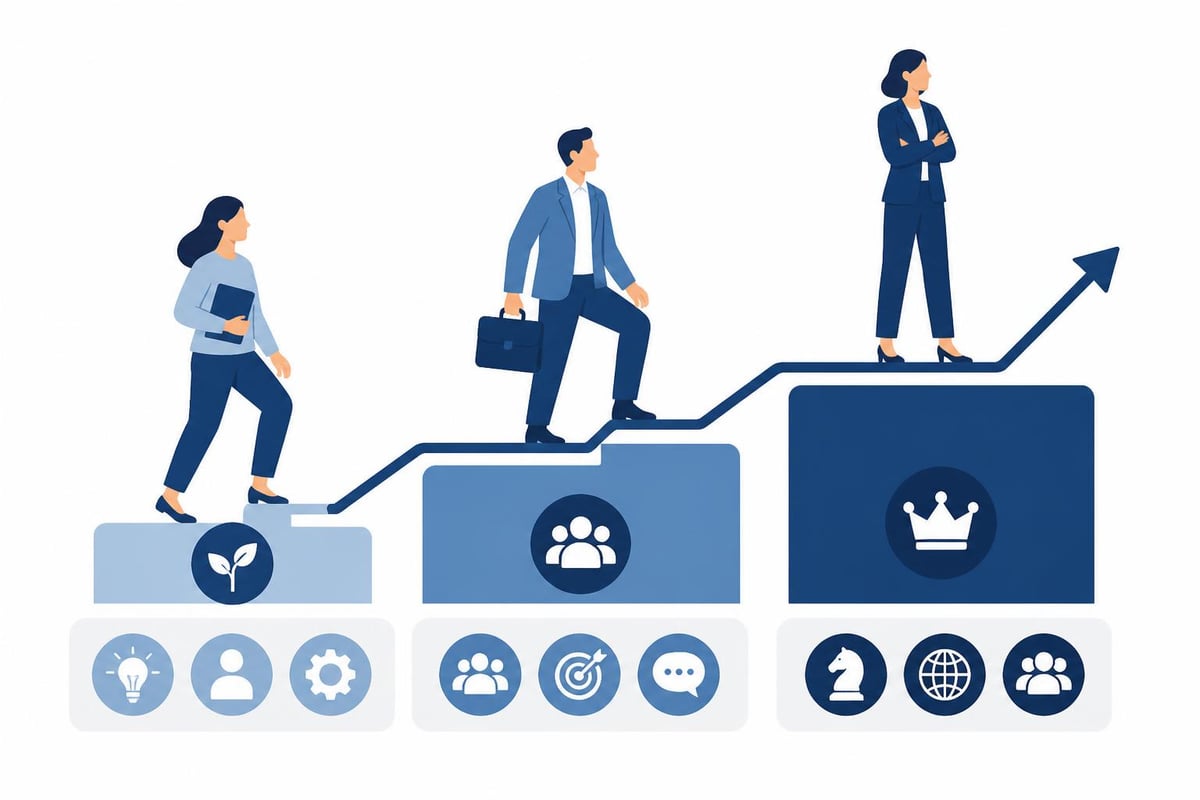
Executive Leadership Development
Senior leaders require sophisticated capabilities that address organizational complexity, market dynamics, and stakeholder management. Executive leadership development training emphasizes strategic vision, cultural transformation, and external relationship building.
Executive programmes explore:
- Organizational design principles that enable scalability
- Board relations and governance responsibilities
- Crisis leadership under extreme pressure
- Innovation cultivation across enterprise structures
- Legacy building and succession planning
Specialized courses like Resilient Leadership Under Pressure prepare executives for high-stakes situations where decisions carry significant consequences.
Critical Skills Development Areas in Modern Leadership Training
Contemporary leadership development training addresses evolving workplace realities that previous generations of leaders never encountered. Remote teams, digital transformation, and generational diversity create new demands.
Emotional Intelligence and Self-Awareness
Technical skills and industry knowledge remain important, but emotional intelligence increasingly distinguishes exceptional leaders from average ones. Self-awareness enables leaders to recognize their impact on others, manage their emotional responses, and create psychological safety.
Emotional intelligence development includes:
- Self-regulation techniques for maintaining composure during stress
- Empathy cultivation that strengthens relationships and trust
- Social awareness of team dynamics and organizational undercurrents
- Relationship management skills for influencing without authority
Organizations partnering with growth strategy firms like ApetureCodex often discover that leadership capabilities directly impact their ability to execute revenue growth strategies. Leaders with strong emotional intelligence navigate organizational change more effectively, enabling successful implementation of new sales, marketing, and partnership approaches.
Strategic Thinking and Decision-Making
Leadership development training must strengthen analytical capabilities alongside interpersonal skills. Leaders make countless decisions daily, and their decision-making quality directly impacts organizational performance.
| Decision Type | Key Considerations | Development Approach |
|---|---|---|
| Strategic | Long-term implications, competitive positioning | Scenario planning, market analysis |
| Operational | Resource allocation, efficiency optimization | Process mapping, data analysis |
| People | Hiring, development, performance management | Behavioral interviewing, coaching skills |
| Crisis | Time pressure, incomplete information | Simulation exercises, stress testing |
The Wikipedia overview of leadership development outlines various methods including formal instruction and developmental job assignments that build strategic capabilities.
Change Leadership and Adaptability
Organizations implementing digital transformation, market expansion, or operational restructuring require leaders who champion rather than resist change. Leadership development training prepares individuals to lead through uncertainty whilst maintaining team morale and productivity.
Change leadership encompasses:
- Communicating compelling visions for why change matters
- Building coalitions of supporters across organizational boundaries
- Addressing resistance with empathy rather than force
- Maintaining momentum through inevitable setbacks
- Celebrating progress to sustain engagement
Specialized training such as AI-Driven Change Management helps leaders navigate technology-driven transformations specifically.
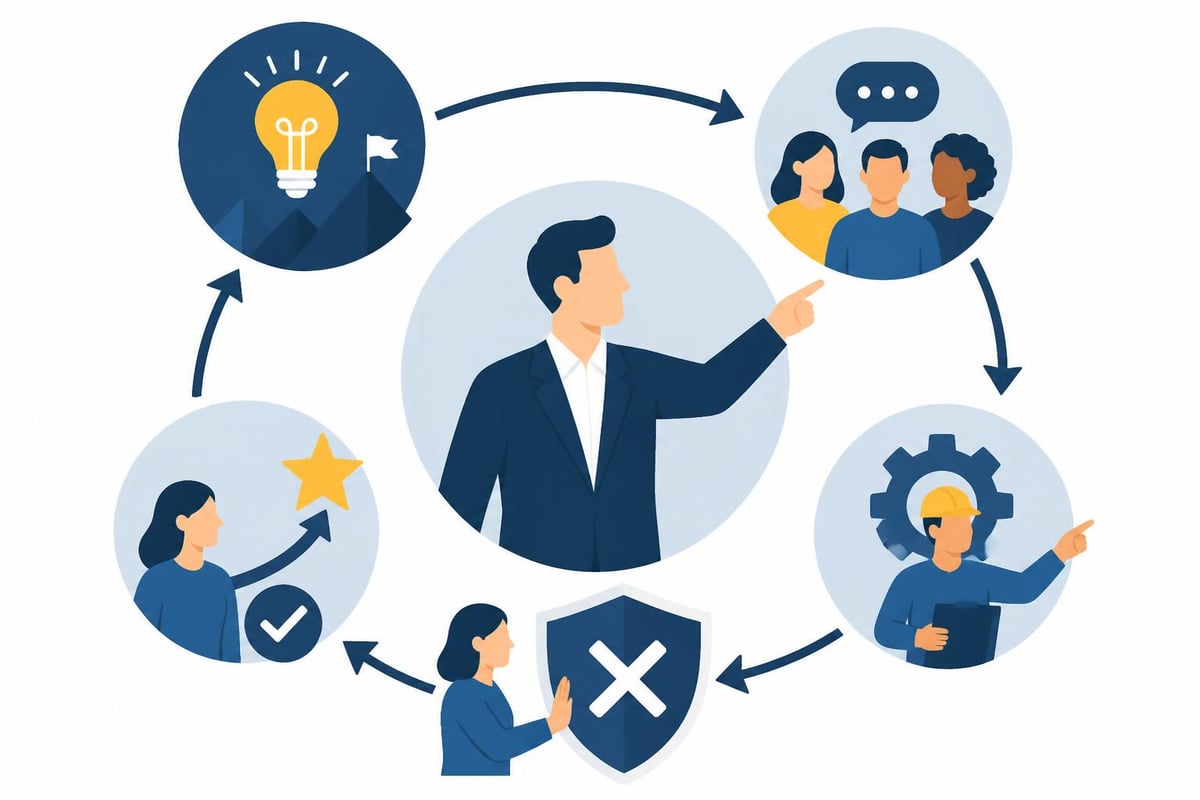
Team Development and Performance Management
Exceptional leaders build high-performing teams that deliver results consistently. Leadership development training addresses both the science and art of team optimization.
Creating High-Performance Team Cultures
Team effectiveness depends on psychological safety, clear expectations, complementary skills, and shared accountability. Leaders cultivate these conditions through intentional design and consistent reinforcement.
Building high-performing teams requires structured approaches that strengthen connection, accountability, and results simultaneously. Leaders learn to:
- Establish clear team charters that define purpose and operating principles
- Facilitate productive meetings that drive decisions rather than drain energy
- Leverage diversity as strength rather than source of conflict
- Create feedback loops that accelerate learning and improvement
- Recognize and reward collaborative behaviors
The team building courses available through comprehensive training providers offer practical frameworks for implementation.
Providing Constructive Feedback
Many leaders struggle with feedback conversations, either avoiding difficult discussions or delivering criticism in ways that damage relationships. Leadership development training transforms feedback from uncomfortable obligation into powerful development tool.
Effective feedback approaches include:
- Regular cadence rather than annual performance reviews
- Specific observations instead of vague generalities
- Future-focused guidance emphasizing growth opportunities
- Balanced perspective acknowledging strengths alongside development areas
- Collaborative problem-solving engaging employees in solution development
Resources on providing feedback complement broader leadership training by deepening this critical skillset.
Measuring Leadership Development Training Impact
Organizations investing in leadership development training rightfully expect measurable returns. Evaluation frameworks should capture both quantitative metrics and qualitative improvements across multiple timeframes.
Short-Term Indicators
Immediate programme completion provides baseline data:
- Knowledge acquisition through pre/post assessments
- Skill demonstration via practical exercises and simulations
- Participant satisfaction measuring engagement and perceived value
- Behavioral commitments documenting intended application
These metrics validate programme design but don't demonstrate organizational impact.
Medium-Term Outcomes
Observable changes typically emerge within three to twelve months following leadership development training:
| Metric Category | Example Measurements | Data Sources |
|---|---|---|
| Employee Engagement | Team satisfaction scores, retention rates | Surveys, HR records |
| Performance Results | Productivity metrics, quality indicators | Operational data |
| Leadership Behaviors | 360-degree feedback improvements | Assessment tools |
| Business Outcomes | Revenue per team, customer satisfaction | Financial systems |
Organizations often partner with strategic marketing firms like Green Mo Marketing Solutions to optimize their growth initiatives, and these partnerships reveal how leadership quality directly influences marketing execution, customer success, and overall business performance.
Long-Term Strategic Impact
Sustained competitive advantage from leadership development training materializes over multiple years:
- Succession readiness with internal candidates prepared for advancement
- Cultural transformation toward desired values and behaviors
- Innovation acceleration through empowered, autonomous teams
- Market performance exceeding industry benchmarks
- Employer brand strength attracting top talent
The U.S. Office of Personnel Management’s leadership development resources emphasize continuous learning and skill refinement as foundations for sustained excellence.
Selecting the Right Leadership Development Training Provider
Organizations face numerous options when choosing leadership development training partners. The decision significantly impacts both participant experience and organizational outcomes.
Evaluation Criteria
Thorough provider assessment considers multiple dimensions:
- Trainer expertise including real-world leadership experience and teaching ability
- Content customization adapting programmes to industry context and organizational culture
- Delivery flexibility offering in-person, virtual, and hybrid options
- Programme breadth providing pathways for different career stages
- Follow-up support ensuring application beyond initial training
Organizations exploring courses across leadership topics benefit from providers offering comprehensive catalogues rather than single-programme specialists.
The Instructor-Led Advantage
Whilst self-paced digital learning offers convenience, instructor-led leadership development training provides irreplaceable benefits. Experienced facilitators adapt content dynamically, address specific participant questions, facilitate peer learning through discussion, and provide nuanced feedback on skill application.
Expert trainers bring diverse industry backgrounds and teaching methodologies that enrich learning experiences beyond standardized content delivery.
Integrating Leadership Development with Organizational Strategy
Maximum impact occurs when leadership development training aligns tightly with broader business objectives. Isolated training initiatives rarely produce sustainable change regardless of programme quality.
Strategic Alignment Process
Effective integration begins with clear articulation of organizational priorities:
- Identify critical business challenges requiring leadership intervention
- Define leadership capabilities necessary to address these challenges
- Assess current leadership bench to identify gaps
- Design development pathways that close priority gaps
- Measure progress against business outcomes rather than training completion
This approach ensures leadership development training directly contributes to strategic execution rather than functioning as disconnected employee benefit.
Creating a Learning Culture
Organizations achieving sustained leadership excellence embed development into daily operations rather than treating it as periodic event. Leaders at all levels model continuous learning, share developmental experiences, and allocate time for skill practice.
Cultural elements supporting leadership development include:
- Psychological safety enabling experimentation and learning from failure
- Time allocation protecting development activities from operational pressures
- Resource investment demonstrating organizational commitment
- Recognition systems celebrating growth alongside results
- Knowledge sharing through communities of practice and peer coaching
Research from UC San Diego on leadership training emphasizes how comprehensive approaches enhance leader knowledge, skills, and abilities more effectively than isolated interventions.
Emerging Trends Shaping Leadership Development Training
The leadership development field continues evolving as workplace dynamics, technology capabilities, and generational expectations shift. Organizations designing programmes for 2026 and beyond must incorporate contemporary realities.
Digital Leadership Capabilities
Remote and hybrid work environments require leaders to inspire, coordinate, and develop teams across digital platforms. Traditional leadership approaches designed for co-located teams often fail in distributed contexts.
Digital leadership training addresses:
- Virtual communication excellence maximizing clarity through limited channels
- Remote team building creating connection without physical proximity
- Digital collaboration tools leveraging technology for coordination
- Asynchronous decision-making maintaining momentum across time zones
- Virtual presence projecting leadership despite physical distance
These capabilities complement rather than replace traditional leadership skills, adding complexity to development requirements.
Inclusive Leadership Practices
Diverse teams outperform homogeneous ones, but only when leaders create environments where all voices contribute. Leadership development training increasingly emphasizes inclusion as core competency rather than compliance obligation.
Inclusive leadership involves:
- Recognizing unconscious biases affecting decisions and interactions
- Actively soliciting perspectives from quieter team members
- Challenging groupthink and comfortable assumptions
- Creating equitable development opportunities
- Addressing microaggressions and exclusionary behaviors
Organizations committed to diversity, equity, and inclusion integrate these elements throughout leadership development training rather than treating them as separate initiatives.
Agile and Adaptive Leadership
Market volatility, technological disruption, and competitive intensity require leaders who thrive amid ambiguity. Leadership development training moves beyond planning and control toward sensing and responding.
Adaptive leadership characteristics include:
- Comfort with uncertainty rather than premature closure
- Experimental mindset testing hypotheses through small bets
- Rapid learning cycles extracting insights from both successes and failures
- Stakeholder engagement incorporating diverse perspectives into decisions
- Resilience cultivation maintaining effectiveness through setbacks
These capabilities enable organizations to navigate complexity without sacrificing coherence or momentum.
Integrating Complementary Skills Development
Leadership effectiveness depends on foundational capabilities that extend beyond traditional leadership topics. Comprehensive development programmes incorporate adjacent skill areas that strengthen overall leadership impact.
Time Management and Productivity
Leaders juggling strategic responsibilities, operational demands, and people development require exceptional time management. Without structured approaches, urgent matters consistently crowd out important leadership work.
Programmes like Time Management That Works and Workplace Time-Saving Strategies provide practical techniques for optimizing leadership capacity.
Effective time management enables leaders to:
- Protect strategic thinking time from constant interruptions
- Model healthy work-life boundaries for their teams
- Delegate effectively rather than becoming bottlenecks
- Prioritize high-impact activities over comfortable busywork
- Maintain energy and focus for critical decisions
Written Communication Excellence
Leadership communication extends beyond verbal interactions to include emails, reports, proposals, and strategic documents. Poor writing skills undermine leadership credibility and create operational inefficiencies.
Professional writing skills training strengthens leaders' ability to communicate clearly, persuasively, and professionally across written mediums. This capability proves particularly valuable for senior leaders whose written communications reach broad audiences and create lasting organizational records.
Listening Skills Development
Despite communication's emphasis on message delivery, exceptional leaders distinguish themselves through superior listening capabilities. Active listening builds trust, uncovers hidden challenges, and demonstrates respect.
Specialized listening skills training helps leaders move beyond hearing words to understanding meaning, emotion, and context. This foundation enables more effective coaching, conflict resolution, and strategic decision-making based on comprehensive information gathering.
Leadership development training represents one of the highest-return investments organizations can make, transforming individual capabilities whilst strengthening overall organizational performance. By selecting comprehensive programmes that address contemporary challenges, align with strategic priorities, and incorporate proven methodologies, businesses create sustainable competitive advantages through their leadership talent. Whether you're developing emerging leaders, strengthening middle management, or preparing executives for complex challenges, My Training Network offers customizable leadership development training programmes delivered by expert instructors across Canada and globally. Our comprehensive catalogue of over 150 courses ensures your organization has access to the specific leadership capabilities your teams need to excel in today's dynamic business environment.

