

Effective communication stands at the heart of professional success. Whether pitching to clients, leading team meetings, or delivering keynote addresses, the ability to present ideas clearly and persuasively separates exceptional professionals from the rest. Presentation skills courses offer structured pathways for individuals and teams to develop these critical capabilities. These training programmes address everything from managing stage fright to crafting compelling narratives, ensuring participants gain practical, immediately applicable skills. For organisations investing in employee development, understanding what these courses offer and how to select the right programme can significantly impact team performance and business outcomes.
Why Invest in Presentation Skills Training
The modern workplace demands constant communication. Professionals present to colleagues, stakeholders, clients, and leadership regularly, making presentation competence a fundamental requirement rather than a specialised skill.
Poor presentation skills cost businesses in tangible ways. Lost sales opportunities, ineffective training sessions, unclear strategic direction, and diminished credibility all stem from inadequate communication abilities. Conversely, strong presenters drive engagement, influence decisions, and inspire action.
Key benefits of formal presentation training include:
- Enhanced confidence when speaking to groups of any size
- Improved ability to structure and organize complex information
- Better audience engagement and retention of key messages
- Stronger personal and organizational brand perception
- Increased persuasive power in sales and negotiation contexts
Research into interactive, evidence-based approaches to training voice modulation skills demonstrates that structured coaching significantly improves vocal delivery, a crucial component of effective presentations. This scientific backing validates the investment in professional development programmes.
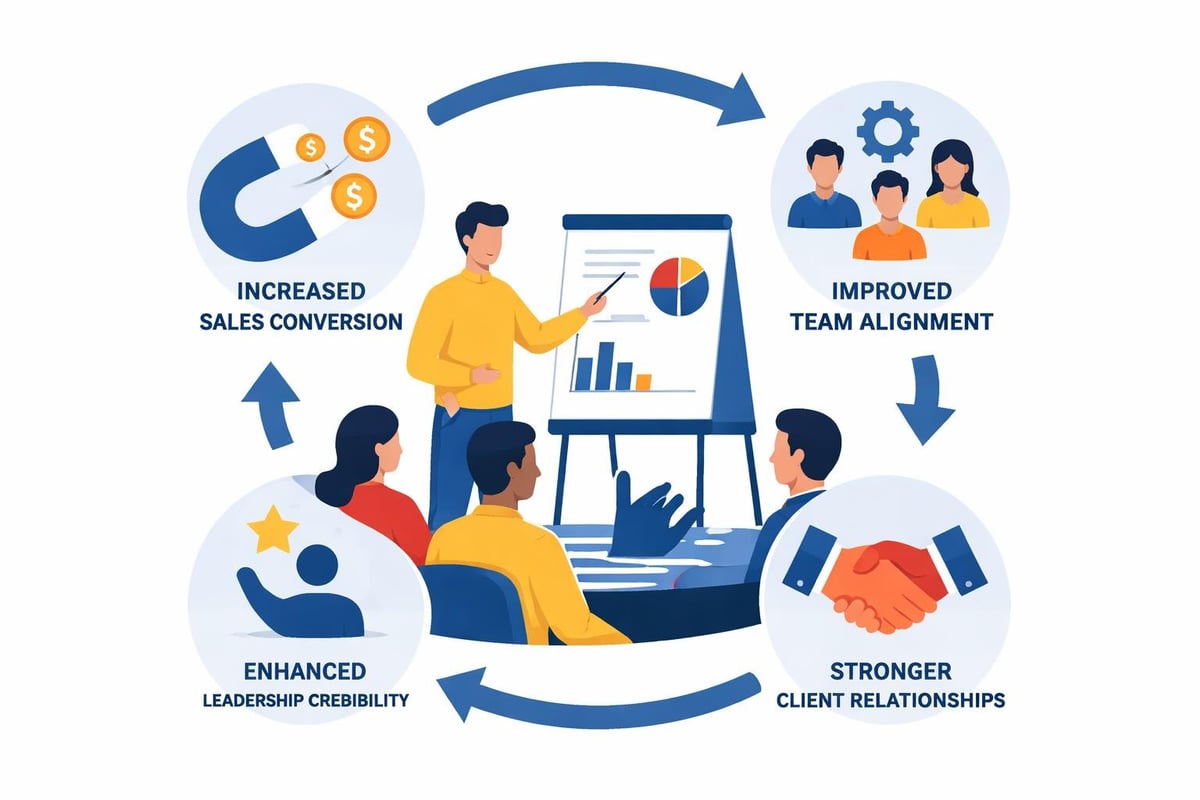
Beyond individual benefits, organisations that prioritize communication skills development create cultures of clarity and alignment. Teams that communicate effectively collaborate more smoothly and execute strategies more successfully.
Core Components of Effective Presentation Training
Quality presentation skills courses address multiple competency areas, recognizing that effective presenting requires mastery across various dimensions.
Content Development and Structure
The foundation of any strong presentation lies in its content architecture. Training programmes teach participants how to identify core messages, organize supporting information logically, and craft narratives that resonate with specific audiences.
Participants learn frameworks such as:
- Problem-Solution-Benefit structures for persuasive presentations
- Chronological storytelling for process explanations
- Compare-contrast models for decision-making presentations
- Question-answer formats for educational sessions
| Content Element | Purpose | Best Use Case |
|---|---|---|
| Opening hook | Capture attention immediately | All presentation types |
| Clear thesis | Establish central message | Strategic updates, proposals |
| Supporting evidence | Build credibility and persuade | Sales pitches, technical briefings |
| Visual aids | Enhance understanding and retention | Data presentations, training sessions |
| Call to action | Drive specific outcomes | Sales, change initiatives |
The practical guidance on crafting effective presentation openers emphasizes techniques to capture audience attention from the first moment, setting the tone for successful communication.
Delivery Techniques and Vocal Presence
Content alone doesn't guarantee success. How presenters deliver their message determines its impact. Professional training addresses body language, vocal variety, pacing, and energy management.
Participants practice techniques including deliberate pausing for emphasis, strategic movement to maintain engagement, eye contact patterns that build connection, and gesture coordination that reinforces verbal messages. These elements transform written content into compelling live experiences.
Studies exploring visual analytics systems designed to help individuals reflect on their speaking effectiveness highlight the importance of self-assessment in developing delivery skills. Modern training often incorporates video recording and analysis, allowing participants to identify improvement areas objectively.
Audience Engagement Strategies
The most polished delivery falls flat if it doesn't connect with the audience. Effective presentation skills courses teach participants to read rooms, adapt to audience reactions, and create interactive experiences rather than one-way broadcasts.
Techniques covered include:
- Asking strategic questions to stimulate thinking
- Incorporating audience participation activities
- Using storytelling to make abstract concepts concrete
- Adjusting pace and depth based on comprehension signals
- Managing Q&A sessions productively
This audience-centric approach ensures presentations achieve their intended outcomes, whether informing, persuading, or inspiring action.
Different Training Formats and Methodologies
Presentation skills courses come in various formats, each offering distinct advantages depending on organizational needs, participant preferences, and learning objectives.
Instructor-Led Workshops
Traditional classroom-style training remains highly effective for developing presentation skills. These programmes typically run one to three days and combine instruction, demonstration, practice, and feedback.
Participants benefit from immediate expert guidance, peer learning opportunities, and controlled practice environments. Instructor-led sessions excel at building foundational skills and addressing common challenges through group discussion.
For organizations seeking comprehensive communication and interpersonal skills development, instructor-led workshops provide structured learning paths with measurable outcomes.
Virtual Training Programmes
The shift to remote work has accelerated virtual training adoption. Online presentation skills courses offer flexibility whilst maintaining interactivity through breakout rooms, screen sharing practice, and digital collaboration tools.
Virtual formats particularly suit geographically dispersed teams and individuals balancing training with ongoing work responsibilities. The best virtual programmes incorporate similar practice opportunities as in-person sessions, ensuring participants gain hands-on experience.

Blended Learning Approaches
Combining self-paced online modules with live practice sessions, blended learning maximizes efficiency whilst preserving essential interactive elements. Participants complete theoretical content independently before applying concepts in facilitated sessions.
This methodology allows learners to progress through foundational material at their own pace whilst reserving valuable instructor time for personalized coaching, advanced techniques, and intensive practice.
Selecting the Right Programme for Your Organization
Choosing appropriate presentation skills courses requires careful consideration of multiple factors to ensure training investment delivers expected returns.
Assessing Organizational Needs
Begin by identifying specific presentation challenges within your organization. Do sales teams struggle with client pitches? Are technical experts unable to communicate complex information accessibly? Do managers lack confidence in all-hands meetings?
Conduct a needs assessment through:
- Employee surveys about communication challenges
- Manager interviews regarding team presentation weaknesses
- Analysis of critical presentation contexts (sales, training, leadership)
- Review of past presentation outcomes and missed opportunities
This diagnostic work ensures selected training addresses actual gaps rather than generic skill development.
Evaluating Training Providers
Not all presentation courses deliver equal value. Examine provider credentials, methodology, customization capabilities, and track records carefully.
| Evaluation Criteria | What to Look For | Red Flags |
|---|---|---|
| Trainer expertise | Real-world presentation experience, relevant credentials | Generic facilitators without specialized knowledge |
| Curriculum depth | Comprehensive coverage of content, delivery, and engagement | Superficial coverage of basics only |
| Practice opportunities | Multiple chances to present and receive feedback | Lecture-heavy format with minimal practice |
| Customization | Ability to tailor content to your industry and contexts | One-size-fits-all approach |
| Follow-up support | Resources, coaching, or refresher sessions post-training | Training ends when workshop concludes |
Organizations benefit from working with providers like My Training Network that offer extensive course catalogues, allowing customization to specific organizational contexts and challenges.
Measuring Training Effectiveness
Establish clear success metrics before training begins. How will you determine whether participants improved? What business outcomes should change as a result?
Common measurement approaches include pre- and post-training assessments of specific skills, observation of real-world presentations with scoring rubrics, feedback from presentation audiences, and tracking of business outcomes tied to presentation effectiveness (sales conversion rates, project approval rates, employee engagement scores).
Research on critical reflection and peer evaluation in communication courses demonstrates that reflective practices enhance skill development, suggesting that effective programmes should include self-assessment components.
Advanced Topics in Presentation Skills Development
Beyond foundational competencies, advanced presentation skills courses address specialized scenarios and sophisticated techniques.
Executive Presence and Leadership Communication
Senior leaders face unique presentation challenges. They must inspire confidence, articulate vision, and represent organizational values whilst managing heightened scrutiny. Advanced training addresses these specific demands.
Topics include managing media interactions, presenting to board members and investors, delivering difficult messages with empathy, and establishing thought leadership through keynotes and panels. These specialized skills distinguish competent presenters from truly influential leaders.
Organizations investing in leadership and management development often incorporate executive presentation training as a core component.
Technical and Scientific Communication
Professionals in technical fields face distinct presentation challenges: translating complex information for diverse audiences, balancing precision with accessibility, and using visual aids effectively to clarify sophisticated concepts.
Specialized courses teach data visualization principles, analogy and metaphor techniques for explaining technical concepts, audience analysis for mixed technical/non-technical groups, and handling challenging technical questions diplomatically.
The emphasis on presentation skills in scientific preparatory courses reflects recognition that scientific excellence requires effective communication abilities.
Virtual and Hybrid Presentation Mastery
The permanent shift toward remote and hybrid work demands new presentation competencies. Presenting effectively through webcams, managing technical platforms whilst maintaining engagement, facilitating hybrid meetings where some attendees are remote, and creating compelling visual content for screen sharing all require specific skills.

Advanced training addresses camera presence optimization, platform-specific engagement techniques (polls, chat interaction, breakout rooms), lighting and audio quality management, and strategies for maintaining energy through screens.
Studies on AI-driven personalized coaching for presentation skills suggest emerging technologies may soon supplement traditional training with ongoing, customized feedback, particularly valuable for virtual presentation skill development.
Implementing Presentation Training Effectively
Securing training is only the first step. Thoughtful implementation ensures maximum return on investment and lasting skill development.
Pre-Training Preparation
Set participants up for success by clarifying training objectives and expectations beforehand. Share specific scenarios they'll practice, assign pre-work to activate relevant knowledge, and create psychological safety by emphasizing that practice environments are judgment-free learning spaces.
Communicate to managers their role in supporting skill application post-training. Without managerial reinforcement, skills often atrophy quickly.
Creating Practice Opportunities
Learning presentation skills requires practice, not just instruction. Effective courses incorporate multiple opportunities to present, receive feedback, adjust, and present again.
Design practice sessions that:
- Start with low-stakes scenarios and build to high-stakes simulations
- Provide specific, actionable feedback focused on improvement priorities
- Include peer feedback alongside expert coaching
- Record presentations for self-review and reflection
- Simulate real organizational presentation contexts
The comprehensive overview of essential public speaking skills emphasizes research, focus, and audience engagement, all of which participants can only truly master through repeated practice.
Post-Training Reinforcement
Training represents a beginning, not an endpoint. Organizations that embed presentation skills development into ongoing professional development see greater returns.
Strategies include assigning presentation opportunities to recently trained employees, establishing peer practice groups for continued skill refinement, providing coaching or mentoring relationships focused on presentation excellence, and creating organizational norms that value presentation quality.
Resources like Cambridge’s structured approach to mastering confident communication can supplement initial training, providing reference materials participants can consult when preparing important presentations.
Industry-Specific Considerations
While core presentation principles apply universally, different industries face unique communication challenges requiring tailored approaches.
Sales and Client-Facing Roles
Professionals in sales contexts need presentation skills tightly integrated with persuasion techniques, objection handling, and relationship building. Training should address pitching to varied stakeholder groups, presenting pricing and value propositions effectively, handling competitive comparisons diplomatically, and adapting presentations based on buying signals.
Healthcare and Scientific Fields
Medical and scientific professionals must translate technical complexity without compromising accuracy whilst maintaining patient or public trust. Specialized training addresses explaining complex diagnoses or research to non-experts, presenting evidence-based recommendations persuasively, and managing emotional responses to difficult information.
Education and Training Delivery
Those who present primarily for educational purposes need distinct competencies focused on learning outcomes rather than persuasion. Training emphasizes assessing learner understanding, adapting to different learning styles, creating interactive learning experiences, and managing diverse classroom dynamics.
Educational institutions, as reflected in curriculum guides that integrate presentation skills training, recognize these skills as fundamental to academic success.
Building a Presentation Excellence Culture
Individual training creates capable presenters. Organizational commitment to communication excellence creates cultures where outstanding presentations become the norm.
This requires leadership modeling of presentation best practices, recognition and reward for presentation excellence, allocation of adequate preparation time for important presentations, and investment in supporting resources (design support, rehearsal spaces, coaching).
Organizations can explore courses focused on effective public speaking that address common fears and develop professional communication skills, creating pathways for continuous development.
When presentation skills courses are part of broader communication development strategies aligned with organizational values and integrated into performance expectations, they deliver transformative results that extend far beyond individual skill gains.
Creating Sustainable Development Pathways
Rather than viewing presentation training as a one-time event, progressive organizations create development pathways that support growth from novice to expert levels.
This might include foundational courses for all employees, intermediate training for those with regular presentation responsibilities, advanced programmes for leaders and key client-facing roles, and specialized tracks for technical communicators, trainers, and executives.
By offering customizable courses across multiple competency areas, organizations can create comprehensive development experiences tailored to individual roles and career trajectories.
Developing strong presentation skills requires commitment, practice, and expert guidance. The right presentation skills courses provide structured learning experiences that transform nervous speakers into confident communicators and good presenters into exceptional ones. Whether your team needs foundational skills development or advanced executive coaching, My Training Network delivers customizable, instructor-led training across Canada and virtually worldwide, offering over 150 courses designed to meet your specific organizational needs.

