

In 2026, the business landscape is changing fast as technology, competition, and workforce expectations evolve. Organisations face a constant need to adapt, making expert training and consulting services more important than ever.
This essential guide aims to demystify training and consulting services, offering a clear pathway for organisations and professionals to navigate the complex world of workplace development. By understanding what these services offer and how to harness them, you can unlock both growth and resilience.
Inside, you will discover definitions, types, and tangible benefits of training and consulting services. You will also find practical strategies for selecting the right partner, explore the latest industry trends, and learn from real-world success stories.
If you are grappling with rapid change or seeking a competitive edge, this guide will help you build interest in proven solutions, create desire for expert support, and inspire action through informed decisions.
Understanding Training and Consulting Services
In today's fast-paced business environment, organisations face constant change and growing skill gaps. To meet these challenges, many turn to training and consulting services for expert support. Understanding what these services offer is the first step to unlocking their full potential.

Defining Training Services
Training services are structured programmes designed to enhance skills and knowledge within an organisation. Delivery methods include instructor-led sessions, virtual classrooms, and blended learning, combining online and in-person elements.
Common types of training services include:
- Soft skills (communication, teamwork)
- Technical skills (IT, software)
- Compliance training (regulations, safety)
- Leadership development (management, coaching)
Investing in employee training is critical for growth and retention. For example, leadership training for emerging managers helps build a strong talent pipeline. According to the ATD Releases 2025 State of the Industry Report, 72% of organisations increased investment in employee training in 2025. This trend highlights the rising importance of training and consulting services for long-term success.
Defining Consulting Services
Consulting services involve expert advice and hands-on support to solve specific business challenges. Consultants work across areas such as strategy, operations, HR, and technology. They diagnose issues, recommend solutions, and often guide the implementation process.
Examples of consulting services include:
- Developing a digital transformation roadmap
- Conducting organisational restructuring via HR consulting
- Improving operational efficiency
The consulting market is set to expand by 9% in 2026, reflecting strong demand for these services. Organisations rely on training and consulting services to navigate complexity and drive change with confidence.
Key Differences and Overlaps
While both training and consulting services aim to improve organisational performance, their approaches differ. Consulting typically focuses on strategic advice and problem-solving. Training is centred on skill-building and knowledge transfer.
However, these services frequently overlap. For example, a digital transformation project may require consulting to set the strategy and training to upskill employees on new systems.
| Aspect | Consulting Services | Training Services |
|---|---|---|
| Focus | Advisory, strategy | Skill-building, learning |
| Delivery | Analysis, guidance | Workshops, courses |
| Example | Process redesign | Leadership coaching |
The most effective solutions often combine both, making training and consulting services a powerful duo.
Who Needs These Services?
A wide range of organisations benefit from training and consulting services. These include:
- Small and medium enterprises (SMEs) seeking growth
- Large corporations managing change or compliance
- Public sector bodies improving service delivery
- Non-profits driving innovation
Common use cases are onboarding new staff, managing organisational change, ensuring compliance, and fostering innovation. Notably, 88% of Fortune 500 companies use external training or consulting, showing how essential these services have become for staying competitive.
Benefits of Professional Training and Consulting
The benefits of engaging professional training and consulting services are substantial. Organisations see improved productivity, increased employee retention, and a stronger competitive edge.
For example, a company that implemented targeted training reported reduced staff turnover and higher engagement levels. The right support can make measurable, lasting impact on business results.
Types of Training and Consulting Services in 2026
The landscape of training and consulting services in 2026 is remarkably diverse, reflecting the evolving needs of modern organisations. As businesses face rapid change, the right mix of tailored solutions becomes essential for sustainable growth and competitiveness.
Corporate Training Solutions
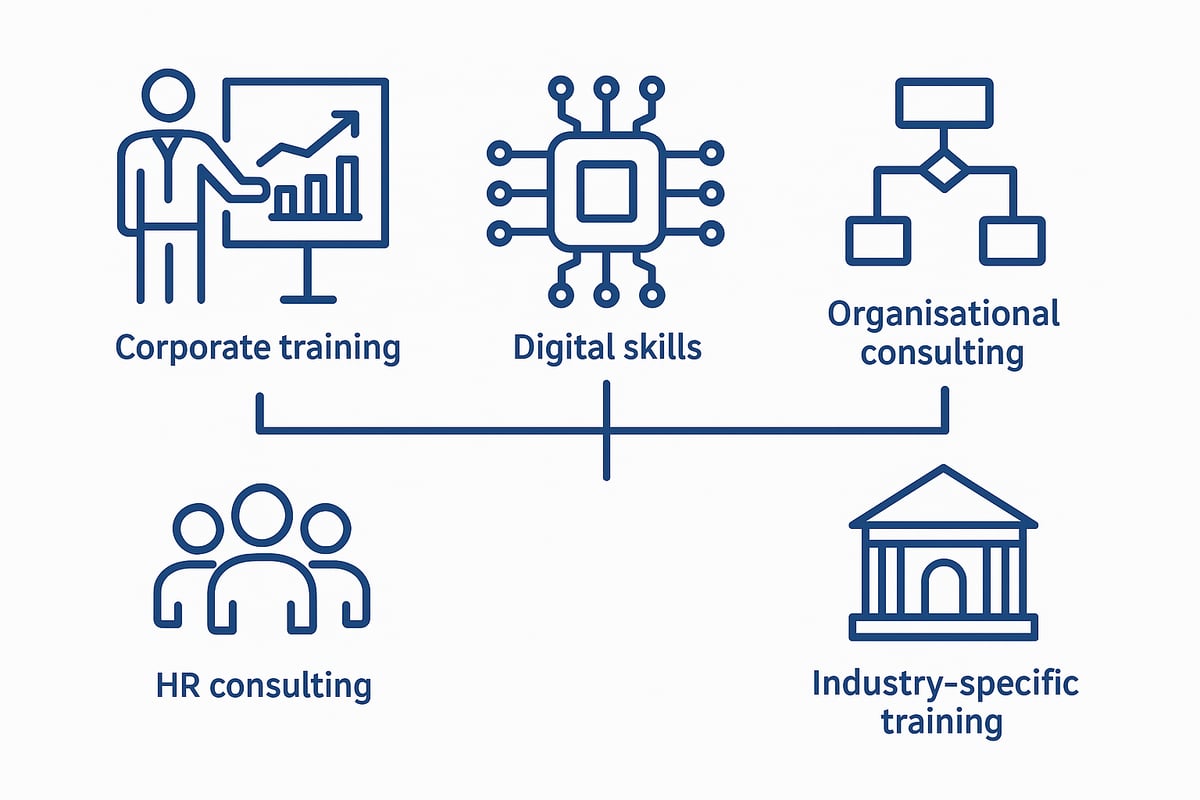
Corporate training solutions form the backbone of many professional development strategies, offering programmes in leadership, sales, communication, and diversity, equity and inclusion (DEI). These solutions are increasingly customised to suit the unique culture and goals of each organisation. For example, soft skills training for hybrid teams is now in high demand as remote and in-person workforces blend.
According to LinkedIn Learning, 60% of companies in 2026 prioritise soft skills development. The flexibility and adaptability of corporate training empower teams to respond effectively to change. To explore the full range of corporate training solutions overview, organisations can review provider offerings and select the best fit for their needs. This highlights the critical role that training and consulting services play in shaping a resilient workforce.
Technical and Digital Skills Training
With technology advancing at a record pace, technical and digital skills training has become vital for future-proofing organisations. These programmes cover IT, cybersecurity, data analytics, artificial intelligence, and automation, ensuring that staff remain up to date with essential competencies.
AI literacy workshops for all employees are increasingly common, bridging the gap between technical and non-technical teams. Digital upskilling is not just about technical roles, but about equipping the entire workforce to thrive. As part of comprehensive training and consulting services, these offerings help organisations stay ahead of industry disruption and capitalise on emerging opportunities.
Organisational Consulting Services
Organisational consulting services focus on strategic challenges such as change management, process improvement, and the implementation of new business models. Consultants work closely with leadership teams to design and execute transformation initiatives that drive measurable outcomes.
For instance, consulting for digital transformation is a top priority, with 50% of consulting projects now centred on digital strategy, according to Consultancy.org. By integrating organisational consulting into broader training and consulting services, companies can align their people, processes, and technology for maximum impact.
HR and Talent Management Consulting
HR and talent management consulting addresses critical issues like workforce planning, recruitment, and diversity initiatives. These services support organisations in building effective talent pipelines and fostering inclusive work environments.
An example is consulting for inclusive hiring practices, which is increasingly sought after as organisations recognise the value of diverse teams. SHRM reports that 45% of HR leaders turn to consultants for talent strategy. The integration of HR consulting within training and consulting services ensures that talent management is both strategic and sustainable.
Industry-Specific Training and Consulting
Industry-specific training and consulting services provide tailored solutions for sectors such as healthcare, finance, manufacturing, and education. These programmes address unique regulatory and operational challenges, ensuring compliance and sector relevance.
For example, compliance training for financial services is essential for meeting evolving regulatory standards. By customising content to sector needs, providers deliver maximum value and impact. This specialisation within training and consulting services helps organisations navigate complexity and maintain a competitive edge.
How to Select the Right Training and Consulting Partner
Choosing the right partner for training and consulting services can shape your organisation’s future success. The selection process requires a careful, strategic approach to ensure your investment delivers measurable results. Here’s how you can navigate the process with confidence.

Assessing Organisational Needs
Begin your selection process by understanding what your organisation truly requires from training and consulting services. Conduct a thorough skills gap analysis to identify where your teams need development, whether in leadership, technical abilities, or compliance.
Align your findings with your broader business strategy. For example, if you are preparing for expansion into new markets, you may prioritise cultural awareness and project management training. Use data from employee assessments and performance reviews to pinpoint critical development areas.
A structured approach ensures you do not overlook hidden challenges. This clarity will help you choose a partner who can tailor their training and consulting services to your specific needs.
Evaluating Provider Credentials and Experience
Once you know your requirements, focus on a provider’s qualifications. Look for accredited organisations with a proven record in delivering training and consulting services within your sector. Review their case studies and success stories, paying attention to outcomes achieved for similar clients.
Industry expertise is vital. For instance, a partner with over a decade of experience in healthcare consulting brings insights that generic providers might lack. Request evidence of certifications and ask about the team’s qualifications and methodologies.
Comparing training partners can be made easier using provider comparison strategies, which offer frameworks to systematically assess strengths and weaknesses. This step reduces risk and ensures you select a partner who aligns with your goals.
Comparing Delivery Methods and Flexibility
Modern training and consulting services come in various formats, including in-person, virtual, and hybrid models. Evaluate which delivery method suits your workforce best. For example, if your employees are spread across multiple locations, virtual or blended learning may provide greater flexibility and access.
Ask providers about their ability to customise content and scale programmes as your needs evolve. Blended learning is increasingly popular, with 70% of organisations preferring this approach in 2026.
Use a comparison table to weigh options:
| Delivery Method | Flexibility | Scalability | Suitability |
|---|---|---|---|
| In-person | Low | Moderate | Local teams |
| Virtual | High | High | Remote teams |
| Hybrid | High | High | Diverse teams |
Choosing the right delivery method will maximise the impact of your training and consulting services.
Analysing Cost, ROI, and Value
Cost is an essential factor, but value matters more. Look for transparent pricing models and ask providers how they measure the impact of their training and consulting services. Will you see reduced onboarding times, improved productivity, or better employee retention?
Calculate the return on investment by comparing the programme’s cost with the measurable outcomes. For example, if a leadership development initiative shortens onboarding by two weeks, quantify the savings in both time and resources.
Prioritise providers who offer ongoing support and outcome measurement. This ensures the value of your training and consulting services extends beyond the initial engagement.
Seeking Client Testimonials and References
Peer recommendations can be invaluable. Ask for testimonials and references from clients who have used similar training and consulting services. Honest feedback highlights both strengths and potential red flags.
Look for detailed case studies that outline the challenges faced, solutions delivered, and results achieved. For example, a digital transformation project that led to measurable efficiency gains demonstrates a provider’s real-world impact.
Trust is built on transparency. A reputable partner will readily share references to help you make an informed decision about your training and consulting services.
Trends Shaping Training and Consulting Services in 2026
The landscape of training and consulting services is evolving rapidly in 2026. Organisations are navigating new technologies, shifting workforce expectations, and global challenges. Understanding these trends is essential for staying ahead and ensuring your organisation’s growth and resilience.
Technology-Driven Learning and Consulting
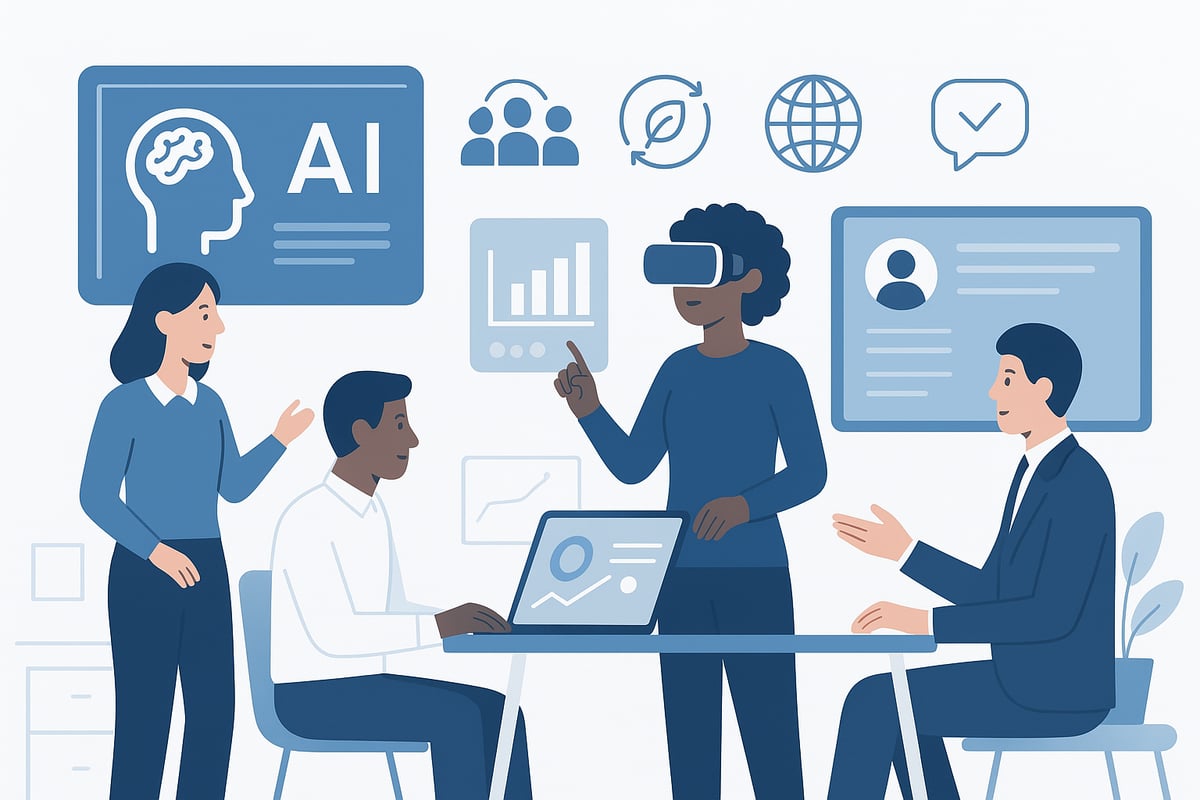
Technology is at the heart of modern training and consulting services. Artificial intelligence, virtual reality, and microlearning platforms are transforming how organisations build skills and solve problems. For example, VR simulations are now standard for safety training, offering immersive, risk-free environments. According to recent benchmarks, 55% of providers deliver AI-driven solutions.
These innovations enable rapid knowledge transfer and tailored interventions. To explore more about the future of business consulting, see the Top Business Consulting Trends to Watch in 2026. Leveraging such tools ensures your organisation remains agile and competitive.
Focus on Personalisation and Customisation
A one-size-fits-all approach is no longer sufficient for training and consulting services. Adaptive learning paths and bespoke consulting frameworks are now the norm. Providers design unique leadership journeys, tailored to management levels and individual needs.
Customisation drives engagement and better outcomes. By aligning content with business goals, organisations unlock greater value from every intervention. This trend ensures that training and consulting services genuinely support growth and innovation across diverse teams.
Emphasis on Diversity, Equity, and Inclusion (DEI)
Diversity, equity, and inclusion are central to effective training and consulting services in 2026. DEI is embedded across programmes, from entry-level workshops to board-level strategy sessions. For instance, DEI consulting now guides leadership teams in building inclusive cultures.
Competitor insights show that 80% of organisations demand DEI components in their training. This focus fosters innovation, improves decision-making, and strengthens employer reputation. Forward-thinking organisations recognise DEI as a strategic priority, not just a compliance measure.
Sustainability and Social Responsibility
Sustainability is shaping the future of training and consulting services. Consulting on ESG compliance and green skills training has become standard practice. Organisations are seeking guidance on sustainability reporting, ethical supply chains, and climate resilience.
For example, tailored workshops help teams understand new sustainability standards. These initiatives contribute to long-term value, supporting both regulatory compliance and positive social impact. Emphasising social responsibility is now a key differentiator in the market.
Globalisation and Remote Delivery
The global reach of training and consulting services continues to expand. Cross-border consulting, multi-lingual training, and 24/7 access are increasingly in demand. Data reveals that 65% of clients now request global delivery options.
Remote and hybrid models break down barriers, making expertise accessible worldwide. This flexibility enables organisations to build skills and solve challenges, no matter their location. The future of training and consulting services is truly without borders.
Step-by-Step Guide to Implementing Training and Consulting Services
Implementing training and consulting services is most effective when approached with clear structure and purpose. Following a systematic process ensures your organisation’s investment leads to measurable growth and lasting results. Here is a practical, step-by-step guide to help you get the most from your training and consulting services journey.
Step 1: Identifying Organisational Goals and Challenges
The first step in implementing training and consulting services is to align with your organisation’s strategic objectives. Begin by identifying key business drivers, upcoming projects, or anticipated changes that require new skills or expertise.
Consider questions such as: What are our growth targets? Are we preparing for digital expansion or regulatory requirements? Pinpointing these challenges helps clarify the purpose of training and consulting services and ensures initiatives support wider goals.
By understanding where your organisation is headed, you lay the foundation for a targeted approach. This clarity will guide every subsequent decision, from provider selection to programme design.
Step 2: Conducting a Skills and Needs Assessment
Next, assess your current capabilities to determine exactly where training and consulting services are needed. Use a mix of methods, such as surveys, interviews, and performance data analysis, to gather insights across teams and departments.
A 360-degree feedback tool can reveal both strengths and gaps, informing your priorities. For example, you might discover a shortage in digital leadership or compliance understanding.
This assessment phase ensures that your training and consulting services address actual needs, not assumptions. It also establishes a baseline for measuring progress after programme completion.
Step 3: Researching and Shortlisting Providers
With your needs defined, start researching providers who specialise in training and consulting services relevant to your objectives. Look for those with a proven track record, industry expertise, and client testimonials.
Consider a range of delivery formats, such as instructor-led training programs, virtual courses, or a blended approach. Create a comparison matrix to evaluate providers on criteria such as:
- Accreditation and certifications
- Customisation capabilities
- Flexibility in delivery
- Client support and post-programme services
Shortlisting the right partners will set the stage for a successful collaboration.
Step 4: Designing a Tailored Programme
Once you have selected your provider, work together to design a bespoke solution that meets your needs. Training and consulting services should be tailored, with clear objectives, KPIs, and content that aligns with your strategic goals.
Co-create the curriculum, ensuring modules address both technical and soft skills. Consider delivery models that suit your workforce, such as hybrid sessions or self-paced learning. Explore options in the online training courses catalog for scalable virtual solutions.
A collaborative approach guarantees your training and consulting services are relevant, engaging, and measurable.
Step 5: Rolling Out Training and Consulting Initiatives
Effective implementation of training and consulting services requires careful planning and communication. Develop a rollout plan that includes:
- Clear communication of objectives to all stakeholders
- Scheduling of sessions or workshops
- Pilot runs with feedback loops
Engage participants early and encourage feedback throughout. Use technology to support virtual or blended delivery, ensuring accessibility for hybrid teams. A structured rollout builds momentum and maximises participation.
Step 6: Measuring Impact and Continuous Improvement
Finally, evaluate the effectiveness of your training and consulting services. Use post-programme assessments, knowledge checks, and ROI analysis to measure outcomes.
Track key metrics such as:
- Knowledge retention rates
- Behavioural changes
- Business performance improvements
Gather feedback from participants and managers to identify areas for refinement. Continuous improvement ensures your training and consulting services remain aligned with evolving business needs and deliver ongoing value.
Real-World Success Stories and Case Studies
Real-world examples illustrate how training and consulting services drive tangible impact across industries. As organisations face evolving challenges, the demand for these services continues to rise, supported by global market forecasts. According to a Forecast Analysis: Consulting Services, Worldwide, the consulting sector is set for significant growth, reflecting its essential role in business transformation.
Digital Transformation in a Retail Organisation
A leading retail chain faced outdated systems and low digital skills among staff. By engaging in comprehensive training and consulting services, they launched a blended digital skills programme. Expert consultants assessed business needs, then trainers delivered interactive workshops to upskill employees.
The result was a more agile workforce, equipped to manage new technology and digital sales channels. Within twelve months, the company achieved a 30% increase in online sales, underscoring the value of targeted interventions. This success reflects a broader trend, with the global technology consulting market projected to surpass $400 billion in 2026.
Leadership Development in a Healthcare Provider
A major healthcare provider identified gaps in its succession planning and leadership pipeline. They partnered with experts in training and consulting services to design a custom leadership academy. The programme included workshops, coaching, and peer learning tailored to emerging managers.
Participants gained critical leadership and communication skills, supporting a culture of internal growth. As a direct outcome, the provider saw a 25% increase in internal promotions within a year. This case highlights how strategic investment in training and consulting services can strengthen organisational resilience and talent retention.
Compliance Training in Financial Services
Financial services firms must respond swiftly to regulatory changes. One institution sought specialised training and consulting services to navigate new compliance requirements. Consultants developed sector-specific content, while trainers delivered interactive workshops for all staff.
As a result, the organisation achieved a 100% compliance rate in recent audits. Employees reported greater confidence in meeting regulatory obligations, reducing risk and enhancing reputation. This demonstrates how tailored training and consulting services safeguard operational integrity in highly regulated sectors.
Process Improvement in Manufacturing
A manufacturing company struggled with inefficiencies and high error rates on the production line. By leveraging training and consulting services, they initiated a lean transformation project. Consultants mapped existing processes, then trainers provided skills workshops on lean methodologies.
The project led to a 15% reduction in production errors and a more engaged workforce. Employees embraced continuous improvement, driving sustainable operational gains. This example shows how training and consulting services deliver measurable productivity improvements in complex environments.

